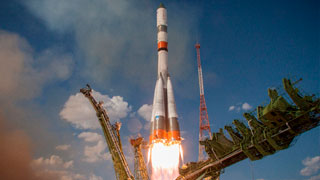

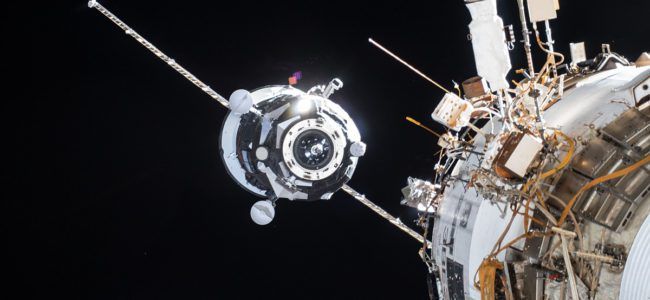
In accordance with the flight program to the International Space Station, today, on February 15, 2021, at 03:45:05 UTC, the Soyuz-2.1a launch vehicle with the Progress MS-16 cargo spacecraft successfully launched from the launchpad No. 6 of Site No. 31 of the Baikonur Cosmodrome. According to the received telemetry information, 8 minutes and 48 seconds after the liftoff, the ship routinely separated from the third stage of the carrier rocket, solar panels and antennas were deployed.
The Soyuz-2.1a carrier rocket has successfully injected the Russian spacecraft into its target orbit. The specialists of the ISS Russian segment Chief Operation Control Group based in the city of Korolev began to control its flight.
Orbit parameters of the Progress MS-16 cargo spacecraft:
- Rotation period: 88.55 min;
- Orbit inclination: 51.67 deg;
- Minimal altitude over the Earth’s surface: 193.06 km;
- Maximum altitude over the Earth’s surface: 241.16 km.
The Progress MS-16 cargo spacecraft will rendezvous with the International Space Station according to a two-day scheme, docking to the Pirs module of the Russian segment is scheduled for February 17, 2021 at 06:20 UTC. The docking is planned to be carried out automatically under the control of the Mission Control Center specialists (part of Roscosmos) and the Russian crewmembers of the ISS-64 Expedition – Roscosmos cosmonauts Sergey Ryzhikov and Sergey Kud-Sverchkov.
The new freighter carries 600 kg of fuel, 420 liters of drinking water for the Rodnik system and 40.5 kg of compressed gases with additional nitrogen reserves, as well as about 1400 kg of various equipment and materials, including the resource equipment of onboard control systems and life support, packages for space experiments, medical and hygiene controls, clothes, standard rations and fresh food for crewmembers.
The cargo bay also contains a repair and recovery kit, consisting of a set of reinforcing linings with an adhesive bond to temporary seal the detected defects in the Zvezda module Transfer Chamber. As part of the Russian scientific and applied research program, the spacecraft carries equipment for the following scientific experiments:
- Neurolab kits are intended to conduct a series of medical experiments Pilot-T to study the impact of long-duration space missions on the quality of professional activities of cosmonauts;
- Materials of experiment Aseptic will enable developing sterility provisions while performing biological experiments under spaceflight conditions;
- Photobioreactor experiment device will be used to study into the feasibility of getting food products and oxygen from algae under microgravity conditions;
- Kaskad experiment hardware will be used as a laboratory to develop efficient methods of biotechnological production of cell cultures under zero-gravity conditions;
- Biodegradation probes will ensure monitoring the composition of microorganisms in the ISS atmosphere to study their impact on structural materials in space conditions.
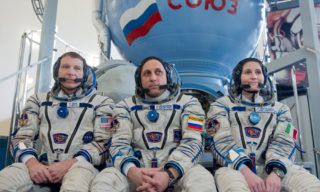
Currently, the 64th long-term expedition crew is working on board the International Space Station. The crew consists of Roscosmos cosmonauts Sergey Ryzhikov and Sergey Kud-Sverchkov, as well as NASA astronauts Kathleen Rubins, Michael Hopkins, Victor Glover, Shannon Walker and JAXA astronaut Soichi Noguchi.