December 15, 2014

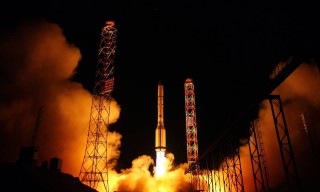
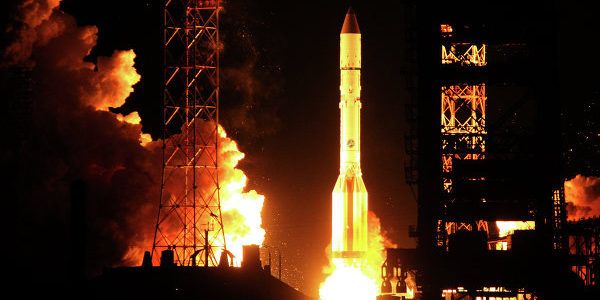
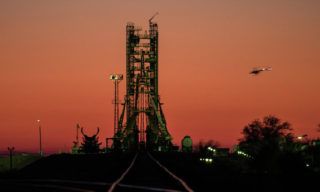
Proton-M booster with Yamal-401 space device belonging to Russian telecommunication operator Gazprom Space Systems was successfully launched from Baikonur spaceport on December 15, 2014.

The launch took place at 03.16, Moscow time as planned. At 03.25 space head comprising Briz-M upper stage and satellite separated from the booster;   Yamal-401 separated from the upper stage at 12.17, – Roscosmos representative reported.

New satellite belonging to orbital group of Russian telecommunication operator Gazprom Space Systems  is aimed to provide Europe and Asia with broadcasting and telecommunication services. The satellite is equipped with 53 transponders and 6 antennas working in C- and Ku- frequences.

The previous launch of Proton-M took place on October 22. That time the booster orbited Express-AM6 telecommunication space device.

Yamal-401 is the third space device designed on the basis of Express-2000 heavy platform. nechnical parameters of teh satellite are as follows:  weight – 2976 kg, power generated from the payload – 11 kWt, operation period – 15 years.
 

More from this category:
July 15, 2014

Baikonur specialists finish preparation works before the launch of Soyuz-2.1a booster with Foton-M biosatellite and Progress M-24M cargo vehicle launch to the ISS both scheduled…

full story
April 3, 2013

According to press service of Gagarin Cosmonaut Training Center, NASA astronaut Kjell N. Lindgren was introduced to the management and instructors of GCTC. Kjell N….

full story
May 31, 2019

On May 30, at 20:42 (Moscow time), the “Proton-M” launch vehicle was launched from Baikonur cosmodrome. The Russian communications and television satellite “Yamal-601” will be…

full story
August 17, 2021

The Soyuz-2.1b launch vehicle with the Fregat upper stage and 34 OneWeb communications satellites was rolled out from the Assembly and Test Facility on Monday….

full story
January 15, 2020

The Roscosmos State Corporation considers the launch of the production of universal rocket modules of “Angara” launch vehicles at the Production Association “Polet” (a branch…

full story
July 1, 2024

In early July, namely 5 July, the Earth will be at the farthest distance from the Sun. In the language of scientists – in aphelia:…

full story
January 14, 2015

A caustic element emitted from an air conditioning unit in the American sector of the International Space Station has forced all of the astronauts to take refuge in the Russian section,…

full story
November 30, 2015

Today GCTC officially saw off ISS-46/47 prime (Yuri Malenchenko,  Roscosmos, Timothy Kopra, NASA, and Timothy Peake, ESA) and back-up (Anatoly Ivanishin, Roscosmos, Takuya Onishi, JAXA,…

full story