

In the Russian segment of the International Space Station the smoke sensors, which are triggered in case of the start of a fire hazard, have been replaced. The operation was routine and was carried out in the service module “Zvezda”. As emphasised by the commander of the cosmonauts of Roscosmos Oleg Kononenko, who now stays on the station as a part of the 71st long-term expedition, the sensors have shown high reliability and sensitivity during the entire period of operation – they can detect smoke, which is not even visible for the eye.
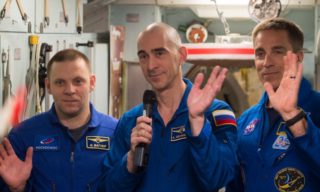
Russian cosmonauts Oleg Kononenko, Nikolai Chub, and Alexander Grebenkin replaced smoke detectors DS-7A, which are a part of the fire detection system “Signal-VM”, on Monday, 17 June. These devices are called optical, although, as Kononenko specified, they operate in the infrared range, so this designation is arbitrary.
As soon as the smoke in the atmosphere reaches a certain level, the sensors detect it and send a signal to the onboard computer system – after that, the emergency alarm is activated. Moreover, the sensors detect smoke even when it is not yet visible. However, such a high sensitivity can sometimes lead to “false alarms”, for example, due to dust. “But these are unavoidable factors. Optical sensors have shown high reliability and stability of operation for a long period of service on the ISS “, – assured Kononenko.
An autonomous system for fire detection is installed in each module of the Russian segment of the ISS. Smoke sensors are usually placed throughout the space – behind the module’s interior panels and outside. The “SMOKE” emergency alarm is issued to the ISS crew even if the smoke level is insignificant.
In addition to the routine replacement of sensors, Russian cosmonauts also performed several scientific experiments on 17 June. One of them is “Terminator”, which involves observing layered formations in the Earth’s atmosphere. We are talking about emission and scattering layers of the atmosphere, such as silvery clouds, which have become much more frequent in the last few decades. Thus, in particular, Kononenko, Chub, and Grebenkin studied the upper mesosphere and the lower thermosphere.
The cosmonauts also worked out the application of 3D printing technologies in space conditions and took images of the Earth to assess the environmental situation. As part of the Vector-T experiment, the methodology for predicting the ISS motion was worked out. In addition, the participants of the 71st long-duration expedition carried out maintenance of the VB-3M bicycle simulator in the Zvezda module.
Earlier, RSC Energia told about another experiment that has been conducted in the Russian segment of the station since 2015. We are talking about “Algometrics”, the purpose of which is to measure the pain threshold of cosmonauts. According to scientists, this kind of research will help improve medical care in orbit.