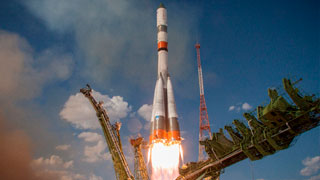
First manned launch to the ISS according to two-orbit rendezvous scheme will probably take place in 2019 RSC Energia specialist Raphail Murtazin stated.
“First spaceflight according to two-orbit scheme may happen in 2017-2018, it will be Progress MS cargo vehicle launch; the first manned spaceflight according to such scheme – in 2019, – as said in the report by Murtazin presented at the Lectures on Cosmonautics on Wednesday.
It will be possible to start applying this new system when Soyuz-2 booster is used for manned launches to the ISS. Murtazin also underlined the importance of Soyuz MS spacecrafts using autonomous navigation system that enables to provide communication with the spacecraft almost during the whole flight.
The medium altitude of the ISS was increased by 3,4 km with the help of European cargo vehicle ATV-4, – Mission Control Centre representative reported….
The Guiana Space Center (French Guiana) continues preparing the Soyuz-ST-B rocket with a Fregat-M upper stage to launch OneWeb spacecraft as part of mission number…
The work of the 59th long expedition is being completed at the International Space Station (ISS). The crew members of the “Soyuz MS-11” spacecraft –…
At the Vostochny cosmodrome specialists from the Vostochny Space Center together with the Progress RSC (parts of Roscosmos State Corporation) completed the cycle of mechanical…
Russian astronomers operating a network of “Master” automatic telescopes discovered a new asteroid between Mars and Jupiter, – Irkutsk State University reported. “The new asteroid…
Russian prime and back-up crew members of ISS-49/50 mission passed preflight exams in GCTC. Last week the crews successfully passed exams on Don-Soyuz and Soyuz-MS…
On May 22, 2020 at 07:31 UTC the Russian Aerospace Forces operational crew successfully launched the “Soyuz-2.1b” carrier rocket with a Ministry of Defense spacecraft…
Specialists of the Vostochny Space Center together with the RSC “Progress”(parts of the Roscosmos State Corporation) on January 10, 2020, began preparing the components of…