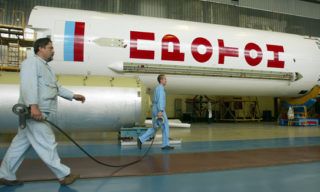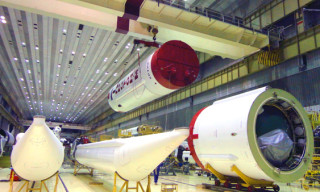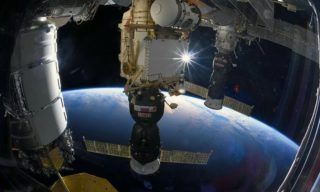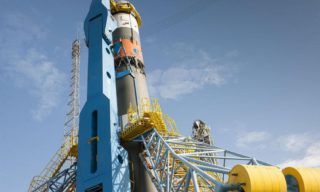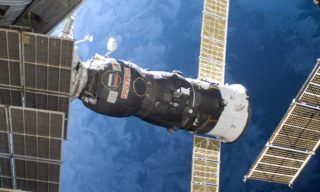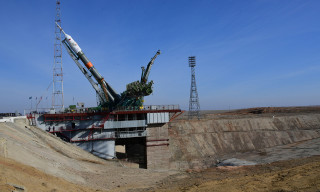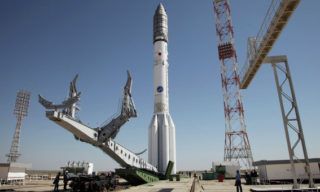
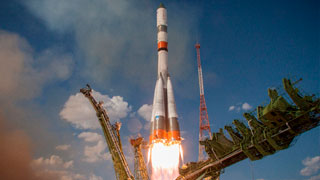

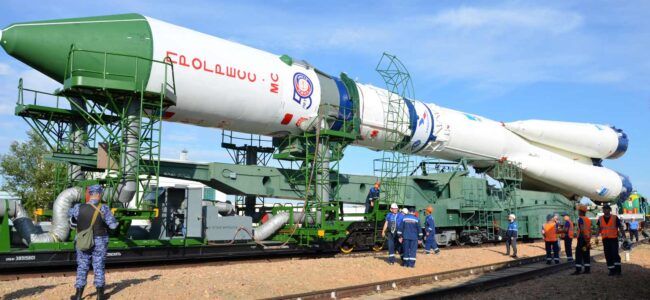
The Soyuz-2.1a launch vehicle, carrying the Progress MS-31 cargo ship, has been transported to the launch pad at the Baikonur Cosmodrome ahead of its launch to the International Space Station (ISS). Specialists continue to prepare for the flight, scheduled for two days from now, on July 3. Preparations are also underway at the ISS itself, where another cargo ship from the same series will depart today.
The day before, on June 30, specialists from Roscosmos Enterprises carried out the final assembly of the Soyuz-2.1a launch vehicle with the Progress MS-31 cargo spacecraft in the assembly and testing building of the 31st site at the Baikonur Cosmodrome. After that, the state commission authorized the assembled structure to be transported to the launch complex. On Tuesday, July 1, the carrier rocket was transported and installed in a vertical position.
The Progress MS-31 will deliver 2,625 kg of cargo to the ISS. Of this, 317 kg consists of essential items for the crew of the 73rd long-term expedition (clothing, sanitary and medical supplies), 344 kg of food, 950 kg of fuel for refueling the station, 420 kg of drinking water, and 50 kg of nitrogen to replenish the ISS atmosphere.
In addition, more than 540 kg on board consists of equipment and consumables for retrofitting and scheduled maintenance of onboard systems, as well as for conducting scientific research. In particular, the “truck” will deliver equipment and consumables to the station for the experiments “Impulse,” “Mirage,” “Fullerene,” Biopolymer, Virtual, Splanch, Biodegradation, Orbita-MG, and Separation.
The launch of the Soyuz-2.1a carrier rocket with the Progress MS-31 cargo ship is scheduled for July 3 at 22:32 Moscow time. Docking with the ISS is scheduled for July 6.
To make room for the new “truck,” tonight the Russian segment of the ISS will be left by its predecessor, Progress MS-29, which has been at the station since November 2024. At 21:39 Moscow time, it will undock from the Poisk module and begin autonomous flight. At around 00:46 Moscow time on July 2, the spacecraft will turn on its engines to begin deceleration, leaving orbit and entering the Earth’s atmosphere.
Most of the spacecraft will burn up in the dense layers of the atmosphere, and the non-combustible elements will fall into an unnavigable area of the southern Pacific Ocean. You can watch the spacecraft depart from the station via live broadcast.
Soyuz-2.1a was manufactured by the Progress Rocket and Space Center (RSC), and Progress MS-31 by the S.P. Korolev Rocket and Space Corporation (RSC). In honor of the 50th anniversary of the Soyuz-Apollo flight, an image symbolizing this historic event was applied to the rocket.
The joint flight of the Soviet Soyuz-19 with Alexei Leonov and Valery Kubasov and the American Apollo with Thomas Stafford, Donald Slayton, and Vance Brand began on July 15, 1975, and their docking in Earth orbit took place on July 17. During the flight, four crew transfers between the two spacecraft were carried out. On July 19, 1975, the spacecraft undocked.