July 18, 2013
Categories: Proton, Roscosmos, Russia

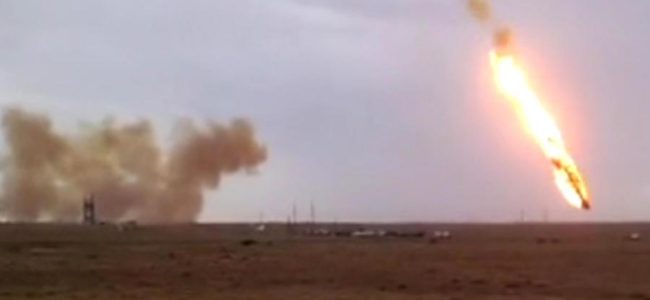
A wide range of problems could cause Proton-M crash with misadjusted angular-rate sensors being just a part of this range, – rocket and space industry expert reported to RIA-NOVOSTI commenting the results of Proton crash investigation by Roscosmos.

Earlier on Thursday Roscosmos Deputy Head Alexander Lopatin heading Accident Board investigating Proton-M crash causes revealed Board’s conclusions. Misadjusted angular-rate sensors were determined to be the cause of the crash.

One of the problems revealed was misadjustment of angular-rate sensors. But there still remain serious questions allowing us to suppose that there was a wide range of problems leading to the crash. It remains unknown why Proton got off the pad 0,4 second earlier. The engine has its time history which is strongly time-bound. Either specialist preparing time history made a mistake or there was a failure in device implementing time history”, – the expert stated. – One more question we still cannot answer is whether where was propulsion system failure or not”, – he added.

“The booster is being checked both at the plant, at the technical area and at the launch pad. I wonder why such mistake as angular-rate sensors misadjustment wasn’t discovered during numerous tests. Either the tests were carried our improperly or those writing test regulations made a mistake, – the expert added. He also pointed out that “if such defect wasn’t discovered in the course of numerous tests it is necessary to tighten control over Zenit boosters’ construction, as its Zenit booster control system is similar to those of Proton-M”.

More from this category:
December 26, 2014

Proton-M booster with European Astra-2G telecommunication satellite will be launched from Baikonur spaceport on Sunday, – Roscosmos spokesman reported. The launch is scheduled for December…

full story
May 13, 2013

According to RIA Novosti, fifteen aircraft and six rescue vehicles will be deployed to ensure the safe recovery of the Soyuz TMA-07M landing capsule when…

full story
February 9, 2021

Prelaunch preparations of the Progress MS-16 cargo spacecraft for the launch under the program of the 77th resupply mission to the International Space Station continue…

full story
July 15, 2024

Vostochny Cosmodrome has received new racks that will allow storing several sets of Angara family launch vehicle blocks. “The assembled racking is located in the…

full story
July 8, 2019

At the Baikonur cosmodrome, specialists from the RSC “Energia” and other Roscosmos enterprises completed refueling operations on the “Soyuz MS-13” spacecraft with fuel components and…

full story
The Russian Federation will complete the second stage of creation of the national orbital station in 2033
June 11, 2024

The second stage of the Russian Orbital Station (ROS) is planned to be carried out in 2031-2033, reported Alexander Bloshenko, executive director of Roscosmos for…

full story
March 17, 2014

Proton M booster with Briz-M upper stage and two communication satellites of Express-AT series was successfully launched from Baikonur spaceport. Briz-M upper stage that was…

full story
July 3, 2024

Roscosmos will create a new satellite constellation for Earth remote sensing “Autograph”. In the first stages, it will include 14 small Pixel-BP spacecraft. The satellites…

full story