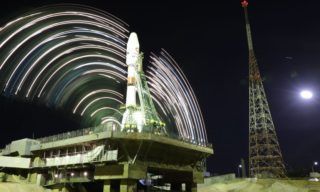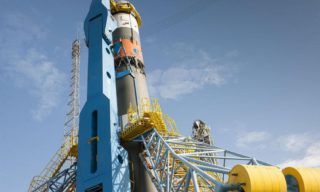
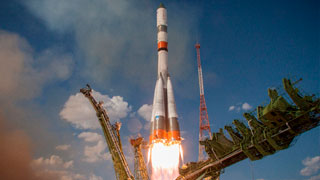


The Soyuz-2.1a launch vehicle with the Progress MS-27 cargo spacecraft has been assembled and transported to the launch pad at Baikonur. The launch is scheduled for May 30. More than 2.5 tons of cargo will be delivered to the ISS, including food for astronauts, equipment for scientific experiments, fuel and nitrogen to replenish the atmosphere of the orbital station.
Specialists of the 31st site of Baikonur Cosmodrome carried out the general assembly of the Soyuz-2.1a launch vehicle with the Progress MS-27 cargo spacecraft. After that, the bundle of the rocket and the spacecraft was taken to the launch complex, where its preparation for launch will proceed.
The launch of “Soyuz-2.1a” with the cargo ship “Progress MS-27” is scheduled for May 30. The ISS will receive 2504 kg of supplies, including 1290 kg of equipment and hardware for the station’s systems, stowage for scientific experiments, as well as clothing, food, medical and sanitation supplies for the crew of the 71st long-duration expedition, 754 kg of fuel for refueling the station, 420 kg of drinking water and 40 kg of nitrogen to replenish the ISS atmosphere.
“Progress MS-27” will also deliver to the station hyperspectrometer for imaging the Earth’s surface in different spectral bands. The device will be used during the experiment called “Hurricane” to solve problems in the field of ecology, agriculture, forestry and water management, monitoring of various emergencies. It will be installed on the porthole inside the service module “Zvezda”. In addition, on board the “spacetruck” stowages for conducting on the ISS scientific experiments “Biopolymer”, “Interaction-2”, “Virtual”, “Correction”, “Neuroimmunity” and “Pilot-T” will be made.
The Soyuz-2.1a launch vehicle was imprinted with images dedicated to the 90th anniversary of the birth of Alexei Leonov, the first man to perform a spacewalk, as well as the 300th anniversary of St. Petersburg State University and the 65th anniversary of the Russian student squads movement.
“Soyuz-2.1a” is a single-use, three-stage medium-class launch vehicle. It has the height of 46.3 meters, it’s diameter is 10.3 meters, and launch mass is about 312 tons. It is capable of launching up to 7.4 tons of cargo into low-Earth orbit and up to 4.6 tons into sun-synchronous orbit. In total, from November 8, 2004 to March 23, 2024, 67 launches of “Soyuz-2.1a” were made, during which 260 spacecraft were put into orbit.
The American manned spacecraft Starliner is also being prepared for launch to the ISS. The date of it’s launch has been postponed many times, but according to the latest data, the launch should take place on June 1 using an Atlas V launch vehicle.