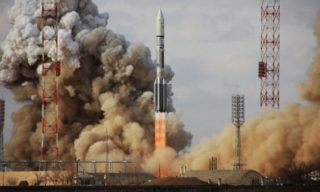
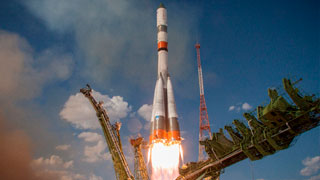


The Soyuz MS-26 manned spacecraft is being prepared for launch at Baikonur. Specialists docked it with the transition compartment of the Soyuz-2.1a launch vehicle before the launch scheduled for September 11. The space vehicle will send a crew of two Roscosmos cosmonauts and one NASA astronaut to the ISS.
Roscosmos specialists carried out work in the assembly and test building of pad No. 254. Before docking, the Soyuz MS-26 was weighed at the workstation and the payload was prepared for stowage.
The transition compartment is part of the head section of the Soyuz-2.1a. It provides a mechanical connection between the spacecraft and the head fairing, as well as integration of the spacecraft command interface into the launch vehicle’s onboard control system.
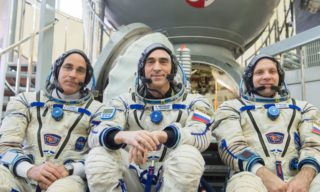
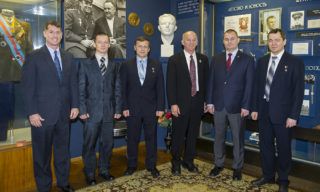
The launch of the Soyuz-2.1a launch vehicle with the Soyuz MS-26 manned spacecraft is scheduled for September 11. On board will be the crew of the 72nd main expedition to the ISS, which includes cosmonauts Roscosmos Alexei Ovchinin (commander) and Ivan Wagner (first flight engineer), as well as NASA astronaut Donald Pettit (second flight engineer). In case of an emergency, Russian cosmonaut Sergei Ryzhikov, Alexei Zubritsky, and American astronaut Jonathan Kim will be their understudies. The new crew is expected to spend 202 days in orbit.
Almost two weeks later, on September 23, the previous ISS-71 crew – Russian cosmonauts Oleg Kononenko and Nikolai Chub along with American astronaut Tracy Dyson on the Soyuz MS-25 spacecraft – will return to Earth from orbit. Before the transport reshuffle, the ISS orbit was raised by 3.4 km: now the station’s average altitude is 419.41 km. Such an operation is necessary for the formation of ballistic conditions.
“Soyuz” – a family of disposable transport manned spacecraft, which replaced the Soviet spacecraft of the first generation – single-seat ‘Vostok’ and three-seat ‘Voskhod’. One of the ship’s many modifications, the Soyuz MS, is based on the Soyuz TMA series, where virtually all internal systems have been updated. Soyuz MS was first launched into Earth orbit on July 7, 2016.
Earlier, Alexey Ovchinin told reporters that the ISS-72 crew plans to conduct more than 40 experiments in orbit, three of which will be new. He also chose a new call sign and weightlessness indicator for the upcoming flight.