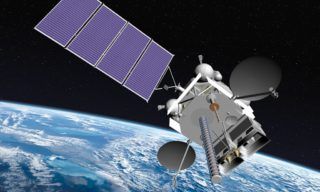



Specialists of the Russian private space company Sputnix have developed a device for high-speed data transmission from a satellite to the Earth. The technology is based on the X-band radio line, which enables communication between the spacecraft and ground stations.
The new development – a highspeed X-band radio link, provides data transmission from onboard satellite equipment at a speed of 600 to 1750 Mbps. The device is characterized by compact dimensions and low weight – no more than 15 kg. This allows its integration into various vehicles, including small satellites.
VRL-X is a data transmission system that can adjust to different conditions. It can change the data rate, modulation type, code rate, and frame size depending on how far away the spacecraft is, what the weather conditions are, what ground terminal is being used, and how much its antenna is amplifying the signal. The system consists of an X-band transmitter based on an active phased array antenna array.
As noted by the creators of the equipment, the technology will speed up the mass production of satellites, as well as help reduce the cost of their manufacture. In addition, the engineers tried to make the device universal in order to install it in spacecraft of both Russian companies and foreign manufacturers.
For its development, Sputnix won the international competition BRICS Solutions Awards in the Sky, Communications, and Space Technologies nomination. Vladislav Ivanenko, General Director of the company, noted that the award testifies to the high level of professionalism of the employees.
Earlier, Sputnix together with the scientists of Samara Korolev University presented the first nanosatellite for Earth remote sensing with a high-resolution hyperspectrometer – only 7 meters per pixel, which is more than larger analogs of both Russian and foreign production. The equipment has successfully passed bench tests in the company’s laboratory and is ready to be sent into orbit by the end of the year.
Sitronics Space, which includes Sputnix, in September announced plans to deliver several dozen satellites into Earth orbit by the end of 2024. This will more than double the Automatic Identification System constellation to 62 spacecraft. In addition, the company already has three remote-sensing satellites in orbit. They will be joined by three other satellites later this year.