

Having successfully passed the exams on manual control of transport manned and cargo spaceships, the main crew of the ISS this Monday continued to pass the “space” exams.
The working week of “Soyuz MS-12” commander Alexey Ovchinin and flight engineer Nick Hague began with the manual-controlled descent exam on the TC-7 simulator, based on the CF-7 centrifuge base.
The upcoming test was aimed at practicing the skills of controlling the descent of a ship from orbit in manual mode.
In the event of an emergency situation, which leads to a failure of automatics during the return to Earth, the crew should be ready to switch to manual control of the descent of the spaceship.
In carrying out this operation, the commander of the ship should observe the basic conditions of training – to put the descent vehicle as close as possible to the calculated poin,t set by the instructors, and to experience minimal overloads.
Taking into account that Alexey and Nick passed such exam on the Soyuz spacecraft several months ago as part of “Soyuz MS-10” crew training, the high level of their knowledge and skills during the training was rated by the commission as “excellent”.
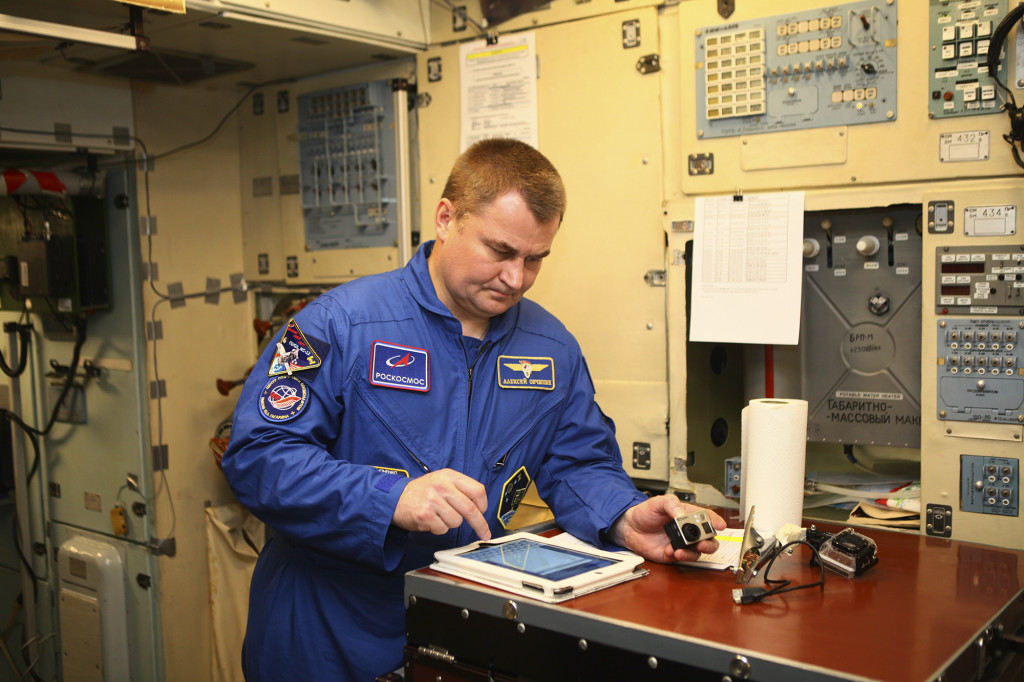
The examination week of the main crew of the ISS continued with a test of knowledge of the Russian segment of the International Space Station.
Training “Typical flight day” was for Alexey Ovchinin, Nick Hague and Christina Koch their first joint training session.
In addition to the main tasks, assigned by the team of instructors, the crew also coped with abnormal situations during training.
Among them – a failure in the life support system, loss of communication with the Earth, medical emergency situation.
Following on-board instructions and using theoretical knowledge of the operation of the ISS systems, the cosmonauts successfully coped with the training program.
At the same time, the crew, who in a week will have to pass complex exams, demonstrated well-coordinated and competent work during the elimination of emergency situations.
At the final stage of training at the station, “depressurization” and “fire” occurred.
The crew training for the flight to the ISS also includes the ability of the commander and the flight engineer to manually control the approach of “Soyuz MS” to the ISS.
These skills are evaluated by the commission during the “manual approach” exam on the “Don-Soyuz” simulator.
After the instructors had simulated an emergency situation, that arose during the approach of the spacecraft to the station, Alexey Ovchinin had to perform a rapprochement with the ISS in manual mode.
Meanwhile, flight engineer Nick Hague, being in the living compartment, gave to the commander the data on the range and speed of the ship, which Alexey used to perform the flight program.
According to the rules of the exam, the assessment of the result of this training is made up of the speed of the mode, the distance of the ship from the docking station, fuel consumption and other criteria.
The two-week training sessions for the main crew of the ISS were the final training for the complex exams, which are to be held by Alexey Ovchinin, Nick Hague and Christina Koch after one week.