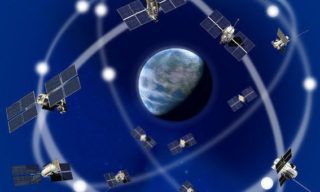


The companies Gonets Satellite System (part of Roscosmos) and Geoscan conducted a joint experiment, during which they were the first in Russia to test the technology of drone control from space. They managed to successfully transmit information about the drone’s location and its telemetry data, as well as send a command to the drone from a ground station using a satellite. As emphasised in Roscosmos, such technology will make it possible to track the UAV’s location in places where there are no other communication channels.
The unique experiment took place based on the Archipelago-2024 project-educational intensive in the Sakhalin Region. The Geoscan 201 drone, equipped with an experimental onboard modem “Gonets” and an antenna in a special lightweight form, was used to test the new technology. Ground tests and drone flights were performed at the “Pushisty” airfield from 13 to 16 July.
During the experiment, the specialists of the two companies wanted to work out three possibilities: to establish communication, to transmit telemetry data from Geoscan 201 to the Gonets-M satellite, and to send commands to the drone from the ground control station via the spacecraft. In total, the drone performed six flights, following the results of which the FTP server of the Gonets system received 218 telemetry messages from the UAV. In addition, it was possible to send three in-flight control commands via feedback, including the forced return of the drone to the launch site.
Tracking the location of Geoscan 201 became possible thanks to the Nebosvod digital platform. It was the platform that received the drone flight observation data. As Alexey Yuretsky, General Director of Geoscan Company, emphasised, satellite systems are more promising and cost-effective in terms of investments compared to ground infrastructure due to their multifunctionality.
Considering the scale of the Russian Federation, its development becomes fundamentally important, as a significant part of the territory of our country is not covered by other types of communication. “Space technologies will make it possible to increase the survey areas for ASF [aerial photography] and correct the flight parameters of UAVs [unmanned aerial vehicles] in case of abnormal situations,” Yuretsky added.
In turn, Pavel Cherenkov, CEO of Gonets Satellite System, said that the past experiment marks “a new era in the development of unmanned solutions.” In particular, it shows how satellite technologies can unlock the potential of the entire industry differently: for example, to provide over-the-horizon control of various drones and obtain the necessary information from the flight zones. And more on that next.
“I am sure that additional opportunities will also open up before us, which we probably have not yet fully appreciated,” Cherenkov is convinced.
At the beginning of June, Geoscan Company announced the creation of a COMMX transmitter, with the help of which it will be possible to send information from satellites to the Earth at high speed (up to 200 Mbit/s). It was developed for the Geoscan 3U satellite platform, but the technology will be used in other projects of the company. Five student CubeSats created at Geoscan are to be launched at the end of the year.