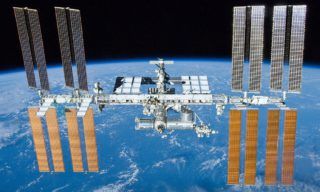
Today, on July 16, 2015, Roscosmos Mission Control Centre and near-Earth Space Monitoring Services of Russia and USA found out that there is possibility of space debris approaching the ISS.
ISS partners took a decision on ISS crew going to Soyuz TMA-16M spacecraft descent module in accordance with the standard measures to be taken in case such situation occurs.
The crew comprising Roscosmos cosmonauts Gennady Padalka and Mikhail Korniyenko and NASA astronaut Scott Kelly spent 10 minutes in the spacecraft.
At 15.00, Moscow time, the crew received a command to bring the system to nominal configuration since the ISS left space debris danger zone without debris avoidance maneuver. The cosmonauts and astronaut got back to their scheduled work onboard the station.
Space industry specialists finish preparang Soyuz-2.1b booster launch with Fregat upper stage, Meteor-M satellite and 6 smaller space devices for the launch . The specialists…
Roscosmos started developing new super-heavy booster, – mass media representatives reported with reference to RSC Energia Director General Vladimir Solntsev. “Together with Roscosmos rocket complex…
Prime (Alexander Skvortsov, Oleg Artemyev, Stephen Swanson) and back-up (Alexander Samokutyaev, Elena Serova, Barry Wilmore) crews go on with their examination session. In course of…
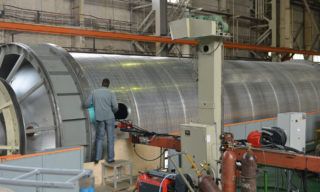
Specialists of RSC Progress (Samara, part of Roscosmos) have finished welding the first stage oxidizer tank (tank ‘O’) for the new Soyuz-5 launch vehicle. The…
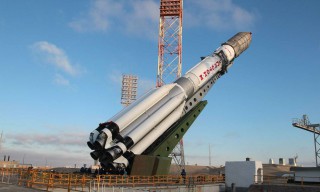
The “Proton-M” launch vehicle is ready for shipment to the Baikonur cosmodrome for preparation under the “Spectrum-RG” program. Dispatch of launch devices including “Proton-M” launch…
Today, on July 9, 2019, the “Proton-M” launch vehicle with the Russian “Spectrum-RG” observatory was delivered to the launch complex of the site № 81…
The International Space Station orbit altitude is to be increased by 890 meters on June 24, 2021 during a reboost with the Progress MS-16 cargo…
At the Baikonur Cosmodrome is undergoing a planned preparations for the launch of the “Eutelsat-5WB” and “MEV-1” satellites by the “Proton-M” heavy carrier rocket. The…