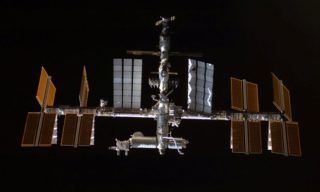


On September 9, 2021, the 65th long-term ISS expedition flight engineers Roscosmos cosmonauts Oleg Novitskiy and Pyotr Dubrov egressed the station for the 50th planned spacewalk under the Russian program (EVA-50). The Poisk Mini-Research Module exit hatch was opened at 14:55 UTC.
Today’s extravehicular activity is the second in a series until the end of 2022, dedicated to the Nauka Multipurpose Laboratory Module configuration, which arrived at the station at the end of July 2021. The cosmonauts are also preparing the station for the arrival of the Prichal Node Module, scheduled to launch in November this year.
In the beginning of today’s spacewalk, Oleg Novitskiy and Petr Dubrov will connect the Ethernet cable to the Multipurpose Module, as well as install the handrail on the new Russian module. In addition, the Russian crewmembers of the ISS are to lay an Ethernet cable, two high-frequency television cables and a Kurs rendezvous system cable between the Zvezda and Nauka modules. This is to be followed by installing a mounting platform with three Biorisk-MSN containers on the Poisk Mini-Research Module.
The main tasks should take about 6.5 hours. If the crew goes ahead of schedule, they will have an additional batch of three groups of operations, which will take about three hours. Oleg Novitskiy and Petr Dubrov will change the pressure and deposition control unit orientation on the Poisk module, mount three additional handrails on Nauka, photograph the 2ASF-1 and 2ASF-2 antennas on the Progress MS-17 transport cargo ship, and infrared vertical sensors 336K-1 and 336K-2 on the Nauka module.
Last time Novitskiy and Dubrov went spacewalking on September 3making it the third longest in the history of Russian cosmonautics after a record 8 hours 13 minutes in 2018 and 8 hours 7 minutes in 2013. For both cosmonauts, this is the third extravehicular activity in their careers. The Russian spacewalk is performed in Orlan-MKS spacesuits No. 4 and 5 with Oleg Novitskiy wearing commander suit with red stripes (Orlan-MKS spacesuit No. 5), and Pyotr Dubrov in the blue-striped spacesuit (Orlan-MKS No. 4).