
October 17, 2014
Categories: GCTC, ISS, Roscosmos, Russia, Space

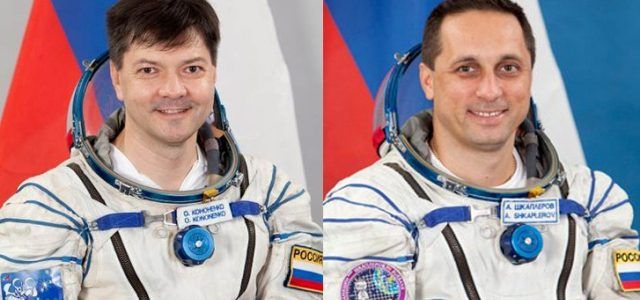
On October 16 Gagarin Cosmonaut Training Centre saw General Medical Board meeting that analyzed the data gained in the result of Russian ISS-42/43 mission crew medical examination over the period of preflight preparation. The Board included Roscosmos Federal Bio-Medical Agency and Institute for Bio-Medical Problems representatives and GCTC medical department specialists.

Following the results of the meeting Roscosmos cosmonauts Anton Shkaplerov (the main crew) and Oleg Kononenko (the back-up crew) were approved for the space flight.

The launch of ISS-42/43 mission crew to the ISS is planned for November 23, 2014, – Roscosmos and GCTC press offices reports.
More from this category:
March 14, 2016

Proton-M booster with ExoMars-2016 station designated to search for life forms on Mars was launched from Baikonur spaceport today on March 14, 2016. The main task…

full story
March 18, 2019

On March 18, 1965, at 10 am (Moscow time), the “Voskhod-2” spacecraft with a crew (Pavel Belyaev and Alexey Leonov) was launched from the Baikonur…

full story
November 25, 2015

New ISS mission back-up crew commander Russian cosmonaut Anatoly Ivanishin says he feels very responsible since his crew will be the first one to go…

full story
July 11, 2013

New communication satellites launch schedule for 2013 may be changed by Roscosmos due to the recent Proton-M crash, – Russian Ministry of Communications and Mass…

full story
May 27, 2019

Today in the morning, the “Proton-M” launch vehicle with the “Breeze-M” upper stage and the Russian “Yamal-601” communications satellite was rolled out to the launch…

full story
September 2, 2020

In order to form ballistic conditions before the launch of the Soyuz MS-17 manned transport spacecraft, the next correction of the International Space Station orbit…

full story
February 13, 2014

Russian Spektr-R space device (“Radioastrion”) was registered in Guinness book of World records as the largest space radiotelescope, – Lebedev Physical Institute Astro Space Centre…

full story
December 16, 2020

The project of new Russian super heavy booster designed for deep space exploration is to be based on methane technologies, – the source stated. Earlier…

full story