

The Russian satellite for remote sensing of the Earth “Kanopus-V” captured the consequences of an explosion in the port of Beirut (Lebanon). A powerful explosion occurred on August 4, 2020 in the area of the seaport of Beirut near the naval base. The presented photographs clearly show the nature of the destruction on the embankment near the explosion site: a number of buildings were demolished by the shock wave. The photo also shows the epicenter of the explosion.
According to local authorities, the cause of the tragedy was the detonation of 2,700 tons of ammonium nitrate confiscated by the customs services stored in the warehouse.
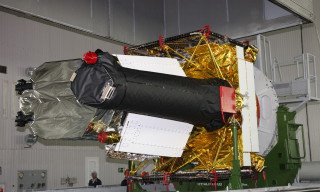
The Kanopus-V space complex is used as part of the Roskosmos Earth remote sensing orbital constellation, designed to obtain panchromatic and multispectral images of the Earth’s surface in the interests of providing units of the Roskosmos State Corporation, EMERCOM of Russia, the Ministry of Natural Resources and Ecology of the Russian Federation, and the Federal Service for Hydrometeorology and monitoring of the environment of Russia, the Russian Academy of Sciences, as well as other departments and commercial consumers with operational information.
VNIIEM Corporation is the head organization-developer of the Kanopus-V spacecraft. The operator of the space system is the Scientific Center for Operational Monitoring of the Earth “Russian Space Systems”. The flight control of spacecraft is carried out by the Flight Control Center of TsNIIMash.
The intended use of the space complex “Kanopus-V” is carried out in accordance with the applications of consumers for obtaining information from remote sensing of the Earth. Reception, processing and distribution of satellite information is performed by the centers of Roscosmos and Roshydromet. The information received from the satellite is in demand by Russian and foreign consumers and is used to solve practical problems.