April 19, 2013
Categories: Moon, NASA, Russia

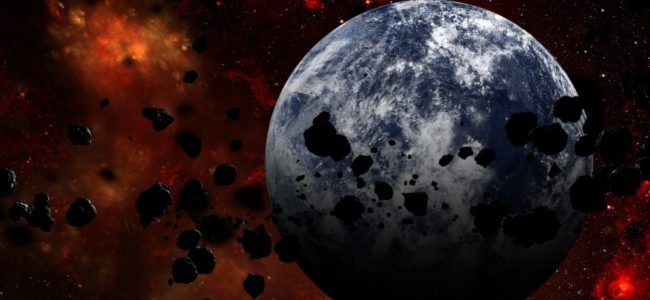
Russian scientists develop a project on creating protective belt on the orbit of small asteroids that could be used to change the orbit of other asteroids threatening the Earth, –  Institute for Space exploration of  Russian academy of Sciences leading scientist Nathan  Acemont.

According to him scientists study whether it is possible to  create a protective asteroid belt at the distance of 100-200 thousand kilometers from the Earth by bringing asteroids there with the help of gravitational maneuvers.

There are some asteroids easy to put into such stationary orbit by means of gravitational maneuvers in regards of the impulse necessary to change their velocity . It appears that there are more than 10 such near-Earth asteroids.  And there will be even more; their quantity will increase at dramatic rate, – Acemont said behind the scenes of international conference on protection from asteroid and comet danger.

According to him it is definitely possible to change the orbit of an object dangerous for the Earth using such asteroids instead of special space devices due to asteroids’ greater impulse. Moreover it would be much easier to get sample of soil from the asteroids of this belt than from the asteroid NASA is going to place near the Moon.

 Russian scientists believe that we have already all technologies to put such project into life despite the fact that there are still some uncertain points that need further consideration.  But the key issues such as whether we have enough fuel, are we accurate enough, or are there asteroids suitable, are already settled, – Acemont said.
More from this category:
February 24, 2022

The Khrunichev Center (a part of Roscosmos) prepared the Proton-M launch vehicle for shipment to the Baikonur Cosmodrome. The rocket is to launch the Russian-European…

full story
November 19, 2021

The Progress M-UM cargo spacecraft-module carrying the Prichal Node Module has been sent to final assembly with the launch vehicle at the Baikonur Cosmodrome Today…

full story
September 15, 2021

34 OneWeb communication system satellites  launched from Baikonur with the help of Soyuz-2.1b booster and Fregat upper stage successfully inserted into the final orbit. The…

full story
April 29, 2013

According to RIA Novosti, Russian astronomers were the first to watch the brightest of the last five years gamma-flash. Gamma-flashes is one of the most…

full story
December 2, 2019

On November 29, 2019, at 13:25 (Moscow time), the “Progress MS-12” cargo spaceship, under the control of the Mission Control Center, undocked from the Russian…

full story
November 28, 2018

On November 27, open training of the main and backup crews of the “Soyuz MS-11” spacecraft took place at the Baikonur cosmodrome. Cosmonauts Oleg Kononenko,…

full story
February 6, 2020

According to ISS flight program Soyuz MS-13 crew comprising commander Roscosmos cosmonaut Alexander Skvortsov, Italian astronaut Luca Parmitano and NASA female astronaut Christina Koch successfully…

full story
September 24, 2019

The State Commission approved the main and backup crews of the spacecraft “Soyuz MS-15”. In addition, the readiness of the “Soyuz-FG” launch vehicle and ground…

full story