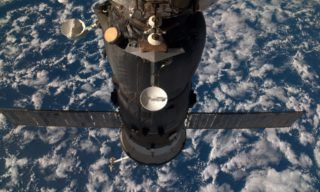


Chinese astronauts successfully completed a spacewalk on 3 July aboard the national orbital station Tiangong. The crew of the Shenzhou-18 manned spacecraft worked overboard for 6.5 hours. During this time, they had time to inspect the station and secure it from space debris.
The crew of China’s Shenzhou-18 manned spacecraft completed its second spacewalk on 3 July at 22:51 Beijing time (17:51 Moscow time). Astronauts Ye Guangfu and Li Qun worked aboard the station, while their colleague Li Guangxu remained on the Tiangong, acting as an assistant.
The extravehicular activity lasted about 6.5 hours. During this time, the astronauts managed to install space debris protection devices on pipelines, cables, and key equipment with the help of a robotic arm and experts on Earth. They also conducted an exterior inspection of the station.
According to the China Manned Spaceflight Programme Administration (CMSA), the Shenzhou-18 crew has already completed one-third of their space mission. Ahead of them are scheduled some more scientific experiments and technology tests. Recall, the spacecraft “Shenzhou-18” with a crew of three people arrived at the Chinese space station “Tiangong” on 26 April. The work in orbit will last about six months, after which the taikonauts are scheduled to return to Earth at the end of October.
In late May, Chinese astronauts broke the national record for the longest spacewalk. Then Ye Guangfu and Li Guangxu spent about 8.5 hours overboard at the Tiangong station. The previous records belonged to the taikonauts from the Shenzhou-16 and Shenzhou-17 crews, who were overboard for about eight hours.
Since then, Chinese astronauts have successfully completed 17 spacewalks. The first one took place on 27 September 2008, when Zhai Zhigang left the Shenzhou-7 spacecraft for about 15 minutes before returning safely. The record for the number of extravehicular activities in a single flight is held by the crew of Shenzhou-15, who went into space four times.