September 4, 2014
Categories: GCTC, ISS, NASA, Roscosmos, Russia, Soyuz, Space

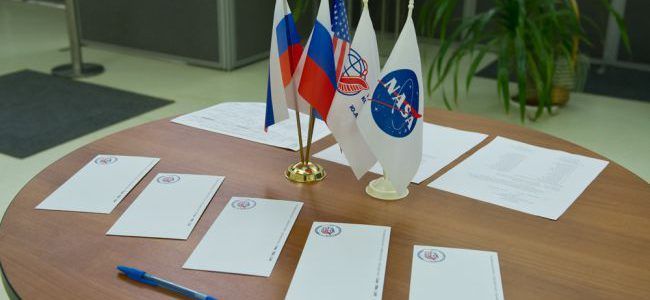
At the beginning of exam the crews got the cards with the list of off-nominal situations possible during the “training flight” on Soyuz TMA-M spacecraft simulator and ISS Russian segment simulator.

The crews were not familiar with the cards’ content, in the course of the training they have to recognize off-nominal situation and determine the course of actions, and terminate it.

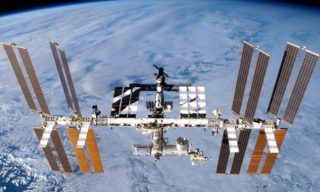
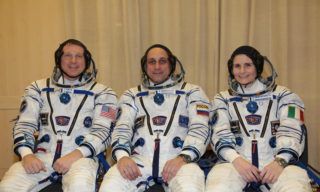
The main crew (Alexander Samokutyayev, Elena Serova and Barry Wilmore) was to face the following situations in the course of trainings on Russian ISS segment simulator:

–          Lack of communication between Russian and US ISS segments;

–          Electron oxygen supply system Electrolytic valve failure;

–          Loss of connection between Laptop and central computer;

–          Urina tank fill;

–          Fire on Russian ISS segment to be terminated with the following atmosphere revitalization

At the same time the back-up crew (Gennady Padalka, Mikhail Korniyenko and Scott Kelly) practiced Soyuz TMA-M flight regimes (insertion, autonomous orbital flight, ISS approaching and docking with the station, undocking and descent) and coped with the following situations:

–          Thermocontrol system failure

–          Failure of main complex of telecommunication means;

–          Central computer failure in the course of the ISS approaching;

–          Descent module depressurization after undocking;

–          Central computer failure during the descent;

–          Engine failure during de-orbit burn


Due to the joint efforts, quick, correct and accurate actions cosmonauts and astronauts coped with all off-nominal situations. Following the 1st training day results State Commission gave both crews excellent marks.
 

More from this category:
March 22, 2016

MCC specialists completed forming Resource-P #3 working orbit increasing its altitude by 70 km. Soyuz-2.1b with Resource-P #3 Earth remote sensing satellite was launched from…

full story
October 12, 2020

On October 11, Soyuz-2.1a booster was rolled out from the integration building and installed onto the launchpad #31. On October 14 the booster will insert…

full story
October 30, 2024

In October, there was an incident that calls into question the safe stay of spacecraft in geostationary orbit – the Intelsat 33e communications satellite exploded….

full story
July 2, 2025

The Soyuz-2.1a launch vehicle, carrying the Progress MS-31 cargo ship, has been transported to the launch pad at the Baikonur Cosmodrome ahead of its launch…

full story
November 19, 2013

Express-AM5 Russian communication satellite developed and designed by Reshetnev “Information satellite systems” Company was delivered to Baikonur spaceport from where it will be launched. “The…

full story
September 5, 2019

In the Assembly and Testing building of site № 254 of the Baikonur cosmodrome, employees of the RSC “Energia” (part of the Roscosmos State Corporation)…

full story
September 12, 2019

The final stage of preparation for the flight of the main and backup crews of the forthcoming expedition to the International Space Station has begun…

full story
July 16, 2013

Lavochkin Research and Production Association developing second Electro-L meteosat will receive the sample of operational Earth monitoring complex this month. After that specialists will be…

full story