April 2, 2013
Categories: RSC Energia, Russia

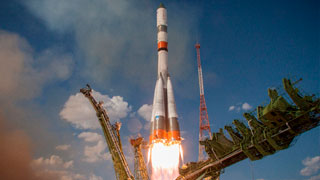
To prevent asteroid threat super-heavy booster is needed, – RSC Energia president Vilatiy Lopota stated.

According to his words the booster is to be developed on the basis of existing flight elements, created in the framework of Energia rocket-booster program. “Such booster will be able to deliver and deploy detection system and tracking system elements and even thermonuclear charge to the dangerous space objects if necessary”, – RSC president explained.

He also pointed out the necessity of Russian asteroid observation system development. “We suggest doing it with the help of three space devices placed at Earth-Moon system Lagrangian points,” –he explained, – with the ISS used as a basis for technologies and cooperation elaboration”.
In his opinion to implement this task a cooperation of different organizations and enterprises including international ones is needed. “Many home and foreign space organizations, institutions and companies we develop cooperation with show the interest in our suggestions” – he emphasized.
Source: novosti-kosmonavtiki.ru
More from this category:
June 17, 2020

Nauka (Science) laboratory module testing conducted in Khrunichev Centre showed good results. Last week space industry specialists successfully finished module body and docking devices pressure…

full story
March 1, 2021

The 36 spacecraft of OneWeb – the company jointly owned by the UK Government and Bharti Global – arrived at Ignatievo airport (Blagoveshchensk) by an…

full story
October 18, 2021

Russian actress Julia Peresild and movie director Klim Shipenko returned from the ISS accompanied by Roscosmos cosmonaut Oleg Novitsky yesterday, on October 17. At 04.14,…

full story
December 19, 2018

The 57th long expedition is being completed at the International Space Station (ISS). The members of the “Soyuz MS-09” international crew cosmonaut Sergey Prokopiev (Roscosmos),…

full story
February 6, 2014

Russia successfully started its 2014 space flight program. Progress M-22M cargo vehicle  launched from Baikonur spaceport on February 5, 20.23 Moscow time, successfully docked with…

full story
December 25, 2014

On December 25, 2014 at 06.01, Moscow timeSoyuz-2.1b booster with telecommunication space device was successfully launched from #43 launchpad of Plesetsk State Test Spaceport. The…

full story
March 24, 2014

A Russian Soyuz rocket launched a Glonass navigation satellite into orbit early Monday morning from northwestern Russia, a spokesperson for the country’s aerospace defense forces…

full story
May 15, 2014

On May 15, 2014 GCTC saw formal parting events: ISS 40/41 main and back up crews were leaving for Baikonur spaceport where they will be…

full story