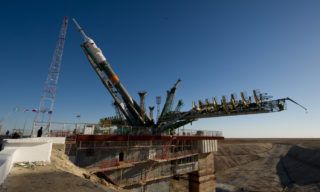
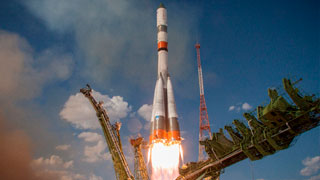


Roscosmos cosmonaut Oleg Novitsky, commander of the Yuri Gagarin (Soyuz MS-18) crewed spacecraft uttered the famous ‘Poyekhali!’ (‘Let’s Go!’) when blasting off from the launchpad just like Yuri Alekseevich Gagarin 60 years before. On Friday, April 9, 2021, at 07:42:41 UTC, the Soyuz-2.1a launch vehicle lifted off from the launchpad at Site 31 of the Baikonur Cosmodrome. In accordance with the flight sequence at 07:51:30 Moscow time, the spacecraft routinely separated from the third stage of the rocket in the target orbit.
According to the received telemetry information, the launch, separation of the stages and the spacecraft went nominally. Currently, the Soyuz MS-18 transport vehicle continues its autonomous flight to the International Space Station under the control of specialists from the Chief Operational Control Group of the Russian Segment of the ISS (Rocket and Space Corporation Energia, part of Roscosmos).
The Soyuz-2.1a launch vehicle injected the spacecraft into orbit with the following parameters:
- Minimal altitude over Earth’s surface: 200.0 km;
- Maximal altitude over Earth’s surface: 242.0 km;
- Circulation period: 88.63 minutes;
- Inclination – 51.6 degrees.
Kazbeki crew are to dock to the station according to the ‘superfast’, two-orbit scheme, reaching the ISS in about 3 hours and 25 minutes after the liftoff. Its berthing to the Rassvet module of the Russian segment of the station is scheduled at 11:07:51 UTC (± 3 min). The second live broadcast will begin at 10:30 UTC in the Online Broadcast section of Roscosmos website. Oleg Novitsky, Pyotr Dubrov and Mark Vande Hei will be welcomed by Roscosmos cosmonauts Sergey Ryzhikov and Sergey Kud-Sverchkov on board the International Space Station, as well as NASA astronauts Kathleen Rubins, Michael Hopkins, Victor Glover, Shannon Walker and JAXA astronaut Soichi Noguchi.
The Soyuz spacecraft received its own name for the second time in the entire history of flights. The Soyuz MS-18 is named after Yuri Alekseevich Gagarin, whose name adorns the surface of the screen-vacuum thermal insulation of the habitable compartment. In addition, the official insignia of the 60th anniversary of the first human spaceflight were placed on the payload fairing of the launch vehicle.