

The Poisk Mini-Research Module exit hatch is closed now, and Roscosmos cosmonauts Oleg Novitskiy and Pyotr Dubrov have completed the 48th planned spacewalk (VKD-48). During their debut extravehicular activity, they successfully installed all the equipment on the outer surface of the Russian segment of the International Space Station. The hatch of the Poisk docking compartment was closed at 13:12 UTC on June 2, 2021. The spacewalk lasted for 7 hours 19 minutes.
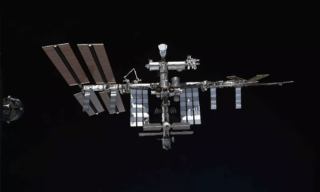
For the second time in the history of the International Space Station operation, the Russian spacewalk was carried out from the Poisk module docking compartment. The module was launched in 2009, but until November 18, 2020, the cosmonauts used the Pirs module for spacewalks. The latter is now being prepared for undocking from the ISS. This is the 55th Russian EVA at the ISS, the first one in 2021 and the debut for both Roscosmos cosmonauts.
As Oleg Novitskiy noted earlier, the peculiarity of spacewalk is the combination of resource work, space experiments and the preparation of the International Space Station to receive the new Nauka module, which is scheduled to launch this summer.
In 7 hours, Oleg Novitsky and Petr Dubrov routinely replaced the removable panel of the fluid flow regulator of the Zarya functional cargo unit and threw the old panel into space. According to the Mission Control Center preliminary assessment, the pressurized container left the International Space Station in the right direction. Within the next 2-3 days, it will completely burn up in the dense layers of the atmosphere. The thermal control system regulator has already been replaced three times due to the end of its life in the history of the ISS.
In addition, the 65th long-term expedition Russian crewmembers prepared the Pirs module for undocking, which arrived in 2001. They removed all external connections between Pirs and the International Space Station: to do so, they removed the M1 upgraded cargo boom from the module, re-docked the cables of the Kurs rendezvous system antennas and removed the handrail system between the Russian Pirs and Zvezda modules. After this operation was completed, the Russian specialists confirmed successful test functioning of the Kurs system after reconnecting. Oleg Novitskiy and Pyotr Dubrov also installed new equipment for the ‘Test’ and ‘Vynoslivost’ Russian scientific experiments to study the effect of space conditions on various microorganisms and materials.
Today’s extravehicular activities were carried out in Orlan-MKS spacesuits (modernized, computerized, synthetic), one with red stripes (Oleg Novitskiy), the other with blue stripes (Pyotr Dubrov). The previous EVA took place on November 18, 2020. The spacewalk is controlled from the TsNIIMash Mission Control Center (part of Roscosmos) by the specialists of the Chief Operating Control Group, responsible for the extravehicular activities of the crew.
Currently, the International Space Station crew includes Roscosmos cosmonauts Oleg Novitskiy and Pyotr Dubrov, NASA astronauts Mark Vande Hei, Shane Kimbrough, Megan MacArthur, ESA astronaut Tomas Pesquet and Japan Aerospace Exploration Agency astronaut Akihiko Hoshide.