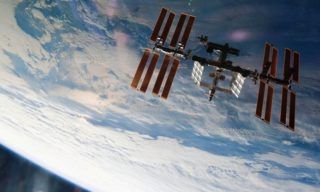


Russian cosmonauts Oleg Kononenko and Nikolai Chub are preparing to break the record for the longest flight on the ISS. The previous record was set last September by Dmitry Petelin and Sergey Prokopyev, who spent 370 days in orbit. But today at 16:06 Moscow time this achievement will be exceeded. However, one of the future record holders Kononenko, who in total will soon fly in space for almost 1,110 days, pointed out that the ISS is slowly but surely aging, and there are fewer and fewer places on the station to store cargo.
The current record for flight duration within the ISS program so far belongs to the participants of the 68th and 69th long-duration expeditions – Russians Sergei Prokopyev and Dmitry Petelin, as well as NASA astronaut Francisco Rubio. They returned from orbit to Earth on September 27 after spending just over a year in space. To be more precise, their flight to the ISS lasted 370 days, 21 hours 22 minutes, and 16 seconds.
Thus Petelin and Prokopyev exceeded the achievement of their compatriot – Peter Dubrov, who spent 355 days 3 hours 45 minutes 21 seconds on the station (from April 2021 to March 2022). But on September 20 at 16:06:51 Moscow time, their record will be broken, as reported in Roscosmos. It is noted that today, September 23, Chub and Kononenko will return home on the Soyuz MS-25 spacecraft after their 374-day flight.
Moreover, Kononenko, who heads the cosmonaut squad of Roscosmos, will mark another achievement at the end of the expedition: his total flight time in space will reach 1,100 days. Earlier in February, he had already broken the world record, surpassing the figure of Gennady Padalka, who for five flights has accumulated a total of 878 days.
However, the problem is that the ISS will soon be decommissioned, reminded Kononenko, who already has five space flights under his belt. According to him, it is not just “aging,” but also “growing fat.” In particular, the cosmonauts are experiencing a “catastrophic” shortage of storage space. On the one hand, this is caused by the desire to provide the ISS with the necessary stock of devices, on the other – due to the constant growth in scientific experiments. As noted by Kononenko, the installation of new equipment is often made at the expense of places of the living area.
Despite this, the state of the orbital complex, both inside and outside, is strictly controlled. For example, in the Russian segment, specialists have been busy throughout the year identifying and solving problems on all station systems. “The condition of the station is monitored strictly and meticulously, as it is one of the most important issues of crew safety,” Kononenko stated.