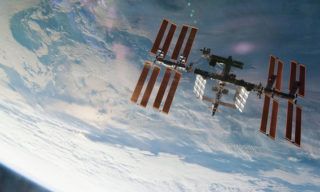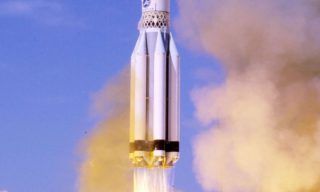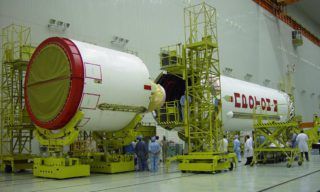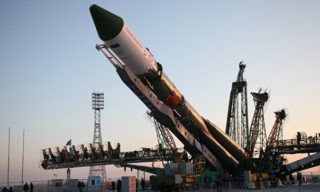


On these simulators cosmonauts practice all stages of work: pre-launch preparation of the transport ship, its launch into orbit, manoeuvring, approach, landing, docking, and flight in conjunction with the ISS. Accordingly, cosmonauts “rehearse” the reverse order of actions: undocking with the International Space Station, descent from orbit, and landing.
A cycle of training is aimed at improving the skills of all these operations. Thus, on 3 July Alexey Ovchinin and Ivan Wagner practiced on the simulator the stages of undocking the spacecraft from the station, descent, and landing. This time the crew was given an emergency – depressurisation of the descent vehicle. This is a serious accident, threatening the life and health of astronauts, so in such a case an emergency descent is needed.
In the case of the normal mode of descent of “Soyuz” the crew takes its place in the descent vehicle, checks the equipment and condition of the cabin, the airtightness of spacesuits, then there are preparations for undocking and undocking itself – the launch of dynamic mode, which “pushes” the ship from the station, then there is manoeuvring and preparation for descent. When the necessary impulse for this is obtained, the “Soyuz” separates into compartments, as a result of which only the descent vehicle returns to Earth.
Emergency descent follows the same scheme, but much faster. The algorithm of actions is prescribed in the onboard documentation.
– It is impossible to give an impulse for descent whenever you want, otherwise the descent vehicle instead of land may fall into the ocean or land in a mountainous area, in the forest, so the crew has a table of time “windows” when they can act. The instructor’s task is not only to introduce emergencies but also to check how the cosmonauts behave during normal operations and during emergencies: quickly or slowly, correctly or not. The crew must be guided by onboard documentation, but sometimes cosmonauts do something in memory, and something can be overlooked, and the instructor must point out all the mistakes. “Flight debriefing” takes place at the end of the training, and not only does the instructor give the participants remarks, but also the crew expresses their wishes, and argues their actions during the work. And at the end, there is always a grade for the training, – said Dmitry Vovk, a leading specialist in cosmonaut training at the GCTC.
Alexey Ovchinin and Ivan Wagner successfully coped with the given emergencies. The cosmonauts are now preparing for the 72nd long-term expedition to the ISS as the main crew. The launch is scheduled for September 2024.