December 6, 2013

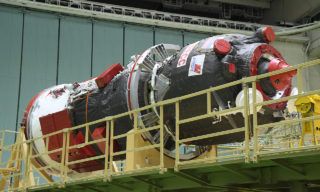
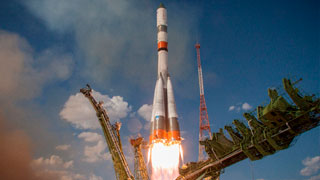
Following the decision of State comission, on December 5 Proton-M launch vehicle with Briz-M upper stage and Inmarsat 5F-1 communication satellite was rolled to and installed on the launch pad of Baikonur spaceport’s site 200. The booster took vertical position, maintenece assembly was attached, all the ground connections were mated.

Specialists of Khrunichev space center together with representatives of other rocket and space industry enterprises started operations in accordance with pre-launch activities schedule.

The launch of Inmarsat 5F-1 satellite with Proton-M booster is planned for December 8, 2013.

Image credit – Roscosmos

More from this category:
February 7, 2014

Main and back-up ISS-39/40 crews started their examinations that will last till late February. Early March cosmonauts and astronauts will start complex examination trainings that…

full story
March 4, 2014

Russian space industry specialists go on with preparations for the launch of Proton-M booster with Briz-M upper stage and cluster comprising two Russian telecommunication satellites…

full story
January 22, 2021

Up to three spacewalks can be performed by the ISS-65 crew in the upcoming expedition to the International Space Station. During The spacewalks will be…

full story
July 31, 2019

On July 30, 2019, at 08:56 (Moscow time) successful launch of the “Soyuz-2.1a” launch vehicle from the Plesetsk State Test Space Center in the Arkhangelsk…

full story
August 29, 2013

European Space Agency and Roscosmos are discussing Europe participation in Russian moon exploration projects, – ESA Head Rene Pischel told the journalists at MAKS-2013 Airshow….

full story
April 7, 2021

This morning the integrated Soyuz-2.1а launch vehicle with the Soyuz MS-18 crewed spacecraft was rolled out of the launch vehicle integration and test facility and…

full story
April 22, 2014

The launch of Russian-German SPACE observatory designed to study black holes, galactic clusters and dark matter was shifted to 2017 since German specialists fail to…

full story
July 1, 2024

In early July, namely 5 July, the Earth will be at the farthest distance from the Sun. In the language of scientists – in aphelia:…

full story