
The life of human in space is very much different from life on the Earth’s surface. The greatest difference is of course the weightlessness effect.
Zero Gravity is a very unusual condition our body is not adapted to. Meanwhile cosmonauts on orbit have to live under such conditions for several long months. Familiarization with this unusual stay begins for them on the ground, during their basic space training stage.
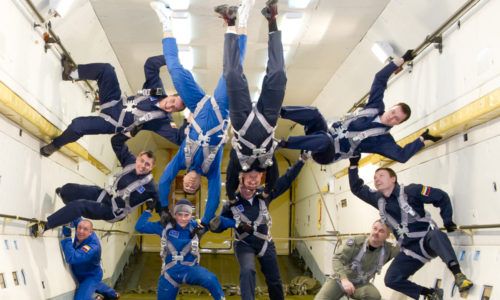
First of all cosmonaut candidates are supposed to complete the theoretical training: study all the document, regulating this kind of flights, learn specifications of the plane, review all the exercises and tasks of the flight program and fulfill the bio-medical training related to weightlessness effect on human body. And only after the medical examination candidates proceed to the practical part.
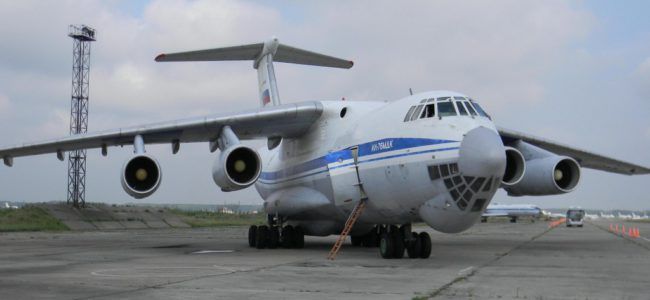
Flights reproducing Zero Gravity are executed with help of special flying laboratory Ilyushin – 76 MDK. During flight test it was figured out that this airplane is the optimal “tool” for such training: it’s a very reliable and highly maneuverable plane, aerodynamics and specifications of which allow flying 25-32 seconds weightlessness modes.
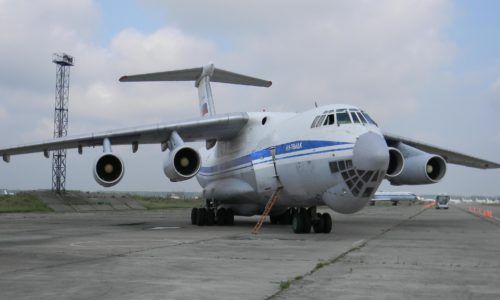
From outside Ilyushin-76 MDK looks like an ordinary transport plane that carries various cargos for long ranges. But as soon as you climb up the airstair and look inside the cabin, the whole similarity goes away. The interior of Il-76 MDK seems to be quite irregular even if you got used to travel by plane a lot. There are no any seats for passengers, and right behind the cockpit it has special work stations of test team lead, flight test-engineers and aircraft medical doctor. The deck of the lab compartment is covered by soft mats, starboard and port sides are made of energy-absorbing panels.
To simulate 0G the flying lab uses so called Kepler’s curve, rising to a height of about 20,000 feet with pitch angle of 45° and load of 2G, and then curving downward. People feel weightlessness in the upper point of parabola, where momentum of inertia equals to gravity force. It lasts around 28 seconds in average depending on meteorological conditions and can be recreated 10 to 20 times within one flight.
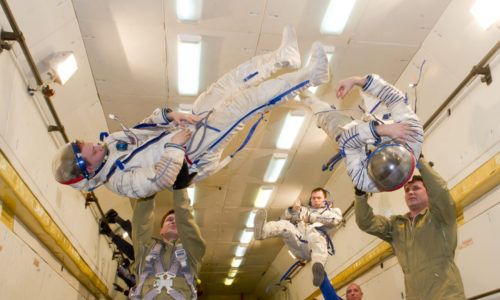
“It is really hard to train many elements and complete multiple tests within such short periods of time. And nevertheless it’s enough to adapt people and give them some skills for operations to be completed in real spaceflight. – deputy chief of GCTC extreme training division, Hero of Russia Viktor Ren explains. All Zero Gravity flights happen under his supervision. – We divide the whole task into segments with duration about 25 seconds, and after completion of a multiple number of modes we collect sufficient information for training process assessment.”
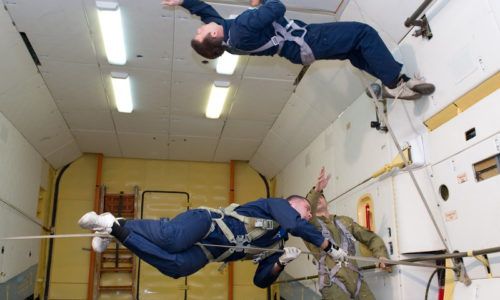
After the completion of the flight, test-team lead Anatoly Zabruskov debriefs cosmonaut candidates and test instructors. According to him, skills acquired during such training are the most important for off-nominal situations, when cosmonauts are supposed to take good decisions within limited period of time and when they must feel confident about how to respond any problem. The more training flights they complete before launch – the more self-confident they feel during their real space mission.
Based on materials of GCTC press-service
Image credit – Gagarin Cosmonaut Training Center