August 20, 2014
Categories: GCTC, ISS, Russia, Soyuz, Space

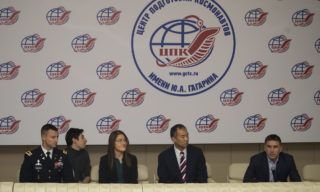
The meeting of State Commission held today in GCTC analyzed the medical data of main and ISS-41/42 mission  main and back-up crew Russian cosmonauts. The commission comprised Roscosmos, Federal  Bio-Medical  Agency, Institute for Bio-Medical Problems representatives and GCTC medical department specialists.

Following the results of the meeting Roscosmos cosmonauts Alexander Samokutyayev, Elena Serova, Gennady Padalka and Mikhail Korniyenko were approved for the spaceflight.
More from this category:
August 7, 2020

The unified state program of space activities of Russia for the period 2021-2030 will be submitted for approval by the government by the end of…

full story
September 19, 2019

Specialists of the RSC “Energia” (part of Roscosmos State Corporation) at the Baikonur Cosmodrome continue preparations for the launch of the “Soyuz-FG” launch vehicle with…

full story
August 28, 2013

Zhukovsky (Moscow Region), August 28. – The 1st launch of Soyuz-2.1v light booster from Plesetsk spaceport is planned for November-December 2013, – Progress State Research…

full story
June 7, 2016

On June 6, 2016,  Roscosmos State Commission meeting discussed Soyuz MS manned spacecraft and Progress MS-03 cargo vehicle prelaunch preparations and Soyuz TMA-19M landing issues….

full story
December 2, 2016

Progress MS-04 cargo vehicle launched to the ISS on December 01, 2016, at 17:51:52, Moscow time, burst at the altitude of 190 km above desolate…

full story
February 15, 2021

At the Baikonur Cosmodrome, the Soyuz-2.1a launch vehicle and the Progress MS-16 cargo spacecraft undergo final prelaunch operations. In accordance with the decision of the…

full story
June 6, 2014

According to official information Proton-M with Exprss-AM4R satellite crash was caused by the breakage of 3rd stage control thruster turbopump bearing, Interdepartmental Commission Head Alexander…

full story
June 14, 2024

A trip to Mars could be a serious test for humans: not only would astronauts have to travel hundreds of millions of kilometres, but they…

full story