March 18, 2020
Categories: Russia

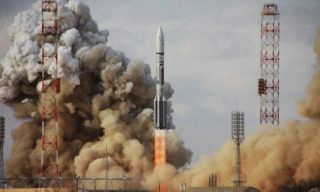
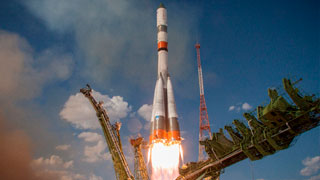
On Monday, March 16, 2020 the “Soyuz-2.1b” launch vehicle with the Glonass-M navigation spacecraft was launched from the launch pad №4 of the Plesetsk cosmodrome by the team of the Aerospace Forces of Russia.

All prelaunch operations and the launch of a space rocket took place normally.
This is the second launch of the “Soyuz-2” launch vehicle, performed in 2020 from the Plesetsk cosmodrome.

The previous launch was successfully carried out on February 20, 2020.

The Soyuz-2 launch vehicle (manufactured by Progress RSC, part of the Roskosmos State Corporation) replaced the Soyuz-U rockets, which were operated at the Plesetsk Cosmodrome from 1973 to 2012.
More from this category:
January 26, 2016

Today, on Tuesday, Proton-M booster with Eutelsat-9B European telecommunication satellite was installed on the launchpad of Baikonur spaceport as planned, – Khrunichev Centre representative reports. The…

full story
July 29, 2021

On Wednesday, July 28, 2021, specialists of the Nauka Multipurpose Laboratory Module flight control group at the TsNIIMash Mission Control Center (part of Roscosmos) performed…

full story
Roscosmos cosmonaut Anna Kikina arrived at the ISS
October 7, 2022

On Friday October 7, 2022 at 00:01 Moscow time, the Crew Dragon manned spacecraft docked to the Harmony node module of the American segment of…

full story
July 16, 2015

On June 15, 2015, Baikonur saw “Mass Media day” taking place in GCTC test and training center of #17 launchpad. Soyuz TMA-17M spacecraft main (Oleg…

full story
June 22, 2024

Scientists at the Korea Institute of Civil Engineering and Construction Technology (KICT) have developed a method of creating bricks from lunar regolith using microwave sintering….

full story
March 13, 2014

ISS orbit was increased by 2 kilometers with the help of Progress M-21M cargo vehicle thrusters, – Mission Control Centre representatives reported. The thrusters were…

full story
October 28, 2015

American astronauts Scott Kelly and Kjell Lindgren are going to perform 6-hours spacewalk to conduct necessary works on ISS outer surface. According to the schedule…

full story
April 22, 2014

The launch of Russian-German SPACE observatory designed to study black holes, galactic clusters and dark matter was shifted to 2017 since German specialists fail to…

full story