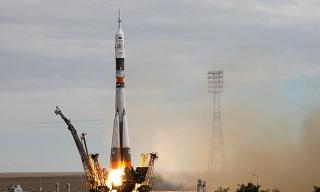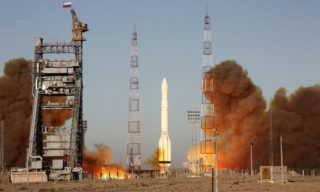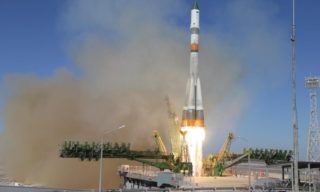
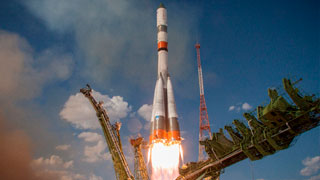


On July 21, 2021 at 14:58:24.938 UTC, the Proton-M carrier rocket launched with the Nauka Multipurpose Laboratory Module from pad No. 39 of Site 200 at the Baikonur Cosmodrome. According to the received telemetry information, all stages of the launch vehicle flight (separation of stages and nose fairing jettison) were nominal.
The Proton-M launch vehicle injected the Nauka Multipurpose Laboratory Module into low-earth orbit with the following parameters:
- Apogee altitude: 375.5 km;
- perigee altitude: 199.0 km;
- Orbit inclination: 51.6 degrees;
- Orbital period: 89.96 minutes.
In accordance with the flight sequence, 580.3 seconds after the liftoff, the space head unit separated from the third stage of the carrier. Further rendezvous with the International Space Station is carried out using the Nauka module own engines. The module will reach the ISS in 8 days. Docking to the Zvezda module is scheduled for July 29, 2021 at 13:26 UTC.
The Proton-M launch vehicle has been manufactured at the Khrunichev Center (part of Roscosmos) and used to launch payloads into target orbits and departure trajectories within the federal and commercial programs since 2001. Over the years of operation, the Proton-M rocket saw four phases of deep modernization, significantly improving its energy-mass and environmental characteristics when injecting heavy single and twin payloads. Today’s launch was the 425th for the Proton rocket and 111th for the upgraded version of the launch vehicle.
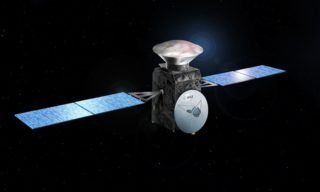
Nauka is a multipurpose laboratory module for the Russian segment of the International Space Station. It was created by the cooperation of enterprises in order to implement the program of scientific experiments and expand the functionality of the Russian segment of the ISS. After its commissioning, the Russian segment will receive additional volumes for the arrangement of workplaces and storage of goods, placement of equipment for the regeneration of water and oxygen.
Module purpose:
- Docking of Progress MS cargo spacecraft, Soyuz MS crewed spacecraft and the Prichal nodal module;
- roll control of the International Space Station;
- receiving fuel from the Progress MS cargo spacecraft, storing it and transferring it to the tanks of the Zvezda module for performing dynamic operations: adjusting the orbit, attitude and stabilization of the ISS;
- storage of cargo delivered for the Russian segment of the ISS;
- ensuring the functioning of the European manipulator ERA;
- functioning of a complex of target loads for the scientific and applied research program with increased comfort of the crew;
- oxygen production to meet the needs of a crew of up to six;
- the functioning of an airlock to work with target loads, also involving the European Robotic Arm manipulator;
- functioning of the on-board workshop and a cabin for the third crew member of the Russian segment of the ISS, as well as ensuring the waste collection system operation with a water regenerating system.