July 24, 2013
Categories: ISS, Progress

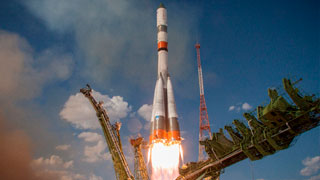
Progress M-18M cargo vehicle being the part of ISS since February 2013 will be undocked from the ISS on Friday, July 26, 2013 and sank in non-navigable region of the Pacific Ocean, – mission Control Centre representative reported to RIA-Novosti.

“The undocking is planned for Friday, July 26, 2013, 00.41 Moscow Time. Engines deboosting and orbit ejection will take place at 04.41 Moscow time, after that Progress will be sank in non-navigable region of the Pacific Oceas”, – the source reports.

More from this category:
January 29, 2021

The Interdepartmental Commission (IAC) for the selection of cosmonauts and their appointment to spacecraft and stations crews decided to recommend Gagarin Cosmonaut Training Center appoint…

full story
September 12, 2013

At 17. 40 Moscow time, on September 11 special charter with Russian crew members of 36 ISS mission Pavel Vinogradov and Alexander Misurkin onboard landed…

full story
March 9, 2021

Processing of the Soyuz 2.1 launch vehicle with the Fregat upper stage is underway at the Baikonur Cosmodrome in advance of the upcoming launch that…

full story
November 10, 2014

At 06:58, Moscow time (03:58, local time),  on November 10 Soyuz TMA-13M spacecraft descent module successfully landed in Arkalyk region. The landing took place nominally….

full story
August 19, 2015

According to Roscosmos both main and back-up crew of new ISS mission arrived in Baikonur. “Soyuz TMA-18M main crew comprising Roscosmos cosmonaut Sergey Volkov, ESA…

full story
April 14, 2014

Russian President Vladimir Putin expressed the hope for future cooperation with International Committee on Space Research (COSPAR). On Friday, April 11 Vladimir Putin had a…

full story
December 15, 2018

The “Soyuz-ST-A” launch vehicle has been rolled out to the launch pad at the Guiana Space Centre to begin final preparations for liftoff. Payload —…

full story
July 9, 2014

At 15.58 (19.58, Moscow time) on July 8, 2014 Soyuz-2.1b booster with Fregat upper stage  and seven space devices: Russian Meteor-M meteorological satellite, Russian MKA-FKI research satellite,…

full story