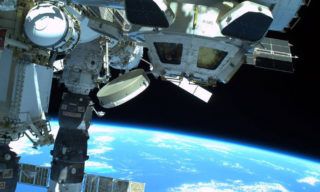


Progress M-20M cargo vehicle, undocked from the ISS on February 3, 2014, that has been performing controlled flight for 8 days during which scientific experiment was carried out on its board, will be deorbited on February 11, – Mission Control Centre representative reported.
Another stage of “Curve: scientific experiment is successfully finished. According to the schedule “Progress will be sank in non-navigational region on February 11. The engines will be ignited for deorbit maneuver at 18.59 Moscow time, the spacecraft will enter the atmosphere at about 19.37 Moscow time.
The destruction of the vehicle starts at 19.42, the debris will fall in non-navigational region of the Pacific Ocean ant 19.48 Moscow time”, – the spokesman stated.
Progress M-20M has been a part of the ISS from July 28,2013. The Curve scientific experiment is aimed at microacceleration level detection, development
of mathematical model of gravitational conditions onboard the station and exploration of onboard systems operating modes impact on the ISS flight conditions.
The experiment description states: “in course of the flight there appear micro accelerations that may exceed rating acceptable for gravity sensitive experiments. That’s why these levels has to be controlled, the development of mathematic models that will enable to determine current micro acceleration levels and predict micro gravity level onboard the station for a given period of time.
“Curve” experiment was started by ISS-1 mission and continues up to the present time. In this period (ISS-1 – ISS-26) about 546 communication sessions was conducted due to which about 3 Gigabytes of information was received. The onset of convection due to the constant micro accelerations onboard the ISS, accelerations connected with station reboost maneuvers, dockings and undocking with Progress-M and Soyuz vehicles was experimentally proved.
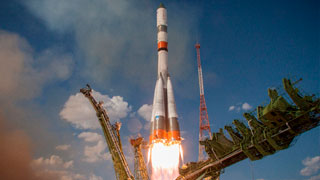
Progress cargo vehicles have been launched since 1972. Since then more than 130 launches was performed with only one of them being a crush at that. Progress M-12M was lost on August 24, 2011 as a result of Soyuz-U booster crash.
Progress M020M flew to the ISS on accordance with the short 6-hours rendezvous scheme while Progress M-19M got to the ISS in 2 days. Progress M-16M, progress M-17M and progress M-18M cargo vehicles delivered the cargoes to the ISS within 6 hours instead of 2 days. Up to Progress M-16M (that was the first to fly to the ISS according to the schor scheme in August 2012) all cargo vehicles flew in accordance with 20days scheme.
The short one was tested on cargo vehicles to use it later for Soyuz manned spacecraft flights. At the present time two Soyuz manned spacecraft have already successfully flown to the ISS according to the short docking scheme.
Image credit – NASA