May 8, 2015
Categories: ISS, Progress, Roscosmos, Russia, Space

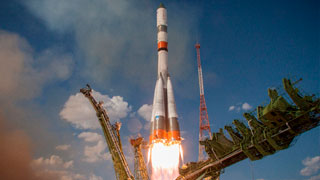
Russian cargo vehicle Progress M-27M re-enterned the atmosphere and burned  in the region above the Pacific Ocean on Friday, May 8, at 05.04, Moscow time.

“The vehicle re-entered dense atmosphere at the 160th orbit above the central part of the Pacific Ocean”, – Roscosmos spokesman reported.

North American Aerospace Defense Command (NORAD) confirmed that Progress M-27M burned in dense atmosphere. According to NORAD the vehicle ceased to exist at 02.20 GMT (plus-minus a minute).
More from this category:
August 22, 2014

Soyuz TMA-14M manned spacecraft is being prepared for the leak tests at Baikonur spaceport. According to Roscosmos press office joint operational crews of Baikonur spaceport,…

full story
August 10, 2015

Russian ISS crew members Gennady padalka and Mikhail Korniyenko are going will open the hatch of Pirs docking compartment today at 17.14, Moscow time. As…

full story
January 9, 2014

The White House has extanded the USA participation in the International Space Station project until 2024, as reported on the website of NASA National Aeronautic and Space…

full story
March 14, 2020

At the Gagarin Cosmonaut Training Center on March 12, 2020, completed the complex examination of the main and backup crews of the ISS-63. The main…

full story
November 1, 2019

On the November 1, 2019 from the Khrunichev Space Center was sent a train with blocks of the “Proton-M” launch vehicle, an upper stage and…

full story
March 28, 2014

Soyuz TMA-12M spacecraft carrying new ISS mission crew successfully docked with the station in automatic mode, – MSC representative reported. Soyuz FG booster with Soyuz…

full story
November 30, 2013

An unmanned Russian resupply spacecraft carrying an improved navigation system docked early Saturday with the International Space Station, Russian Mission Control said. The docking had…

full story
October 7, 2021

The Soyuz MS-19 spaceship crewmembers, which docked on October 5, 2021 to the Rassvet Mini-Research Module of the Russian segment of the International Space Station,…

full story