May 6, 2015

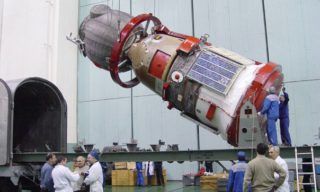
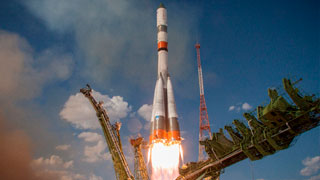
According to Roscosmos specialists’ calculations Progress M-27M cargo vehicle launched on April 28, 2015 will  re-enter the atmosphere in the time period from 01:23 to 21:55, Moscow time. A day before the factored moment Roscosmos will report more precise data on time and possible region of Progress debris fall.

The spacecraft will burn in dense atmosphere with only small debris being able to reacth the Earth. The size of the debris is similar to those in case of nominal Progress cargo vehicle de-orbiting.

More from this category:
January 13, 2016

NASA astronaut Scott Tingle and JAXA astronaut Norishige Kanai started their preflight trainings in Gagarin Cosmonaut Training Centre in Star City, Moscow region. “I am…

full story
November 19, 2021

The Progress M-UM cargo spacecraft-module carrying the Prichal Node Module has been sent to final assembly with the launch vehicle at the Baikonur Cosmodrome Today…

full story
July 7, 2020

The first launch in six years of the new-generation navigation satellite Glonass-K from the Plesetsk cosmodrome is scheduled for August. “The satellite’s delivery to the…

full story
Anna Kikina left for the U.S. to continue training for her flight on the Crew Dragon
August 5, 2022

On Friday, July 29, 2022 Roscosmos cosmonaut Anna Kikina left for U.S. to continue training for the flight on the Crew Dragon to the International…

full story
February 9, 2022

At the Baikonur Cosmodrome, the Progress MS-19 cargo spacecraft preflight preparation continues for launch under the 80th resupply mission to the International Space Station. On…

full story
March 3, 2015

Russia plans to launch 12 boosters in the next three months, – spokesman for Rocket and Space industry reports. According to him spring program will…

full story
October 15, 2014

Preparation works for the next launch of Proton-M booster with Briz-M upper stage and Express-AM6 satellite are under way at Baikonur. On October 13 Khrunichev…

full story
November 30, 2015

Today GCTC officially saw off ISS-46/47 prime (Yuri Malenchenko,  Roscosmos, Timothy Kopra, NASA, and Timothy Peake, ESA) and back-up (Anatoly Ivanishin, Roscosmos, Takuya Onishi, JAXA,…

full story