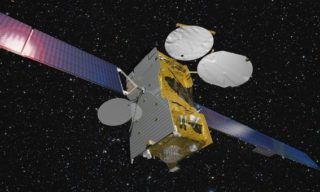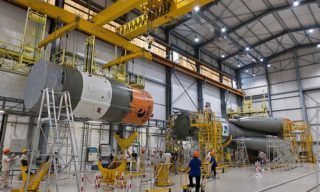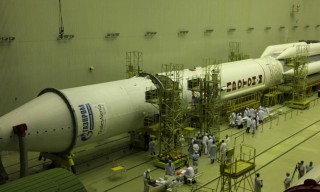
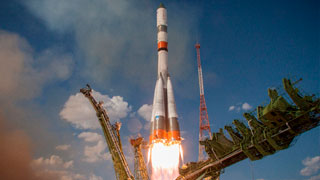


In accordance with the flight program to the International Space Station, on June 29, 2021, at 23:27:20 UTC, the Soyuz-2.1a launch vehicle successfully lifted off from the launcher No. 6 of Site 31 (Vostok) of the Baikonur Cosmodrome with the Progress MS-17 cargo ship. 8 minutes 49 seconds after the liftoff, the spacecraft separated normally from the third stage of the carrier, the solar panels and antennas deployed afterwards.
The Soyuz-2.1a launch vehicle successfully injected the Russian spacecraft into its target orbit. Specialists of the Chief Operating Control Group for the Russian Segment of the International Space Station (Rocket and Space Corporation Energia, part of Roscosmos) have taken over flight control.
Progress MS-17 cargo vehicle orbit parameters:
- Rotation period: 88.54 min;
- Orbit inclination: 51.67 deg;
- Minimal altitude over the Earth’s surface: 193.06 km;
- Maximum altitude over the Earth’s surface: 240.87 km.
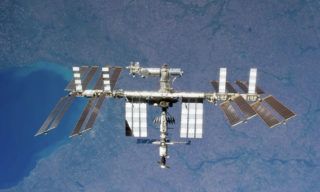
The Progress MS-17 cargo vehicle will reach the International Space Station after a two-day flight. The docking to the Poisk Mini-Research Module 2 of the Russian segment is scheduled for July 2, 2021 at 01:02 UTC. Docking is planned to be automatic supervised by the TsNIIMash Mission Control Center specialists (part of Roscosmos) and the ISS-65 Expedition Russian crewmembers: Roscosmos cosmonauts Oleg Novitskiy and Pyotr Dubrov.
The craft will deliver 470 kg of fuel to the ISS, as well as 420 liters of drinking water in the Rodnik system tanks, 40 kg of air and oxygen, 1,509 kg of various equipment and materials in the cargo bay, including hardware and maintenance means for onboard systems, kits for space experiments, medical control and sanitary and hygienic supplies, clothing items, standard food rations and fresh food for the crew of the 65th long-term expedition.
In addition, a complex of target payloads will be delivered to the station as part of the Russian program of scientific and applied research and experiments:
Neurolab kits are intended to conduct a series of the Pilot-T medical experiments to study the impact of long-duration space missions on the quality of professional activities of cosmonauts;
Materials of the Korrektsiya experiment are used to develop effective countermeasures of cosmonaut osseous lesion under zero-gravity conditions;
Biorisk and Konstanta-2 kits serve as a laboratory to study the spaceflight factors impact on the state of complex albuminous compounds and survivability of microorganisms;
The Probiovit experiment is aimed at development of production technology of pharmaceutical products with immunomodulatory effects under zero-gravity conditions;
The UF Atmosphere hardware ensures detailed mapping of the global structure of genenschein of the Earth’s atmosphere to study meteorological processes and space weather.
The launch of the Progress MS-17 cargo vehicle under the 78th supply mission program of the International Space Station is dedicated to the 75th anniversary of the Special Design Bureau OKB-1 formation (today – RSC Energia named after S.P. Korolev). The enterprise was created based on the Moscow Region Research Institute-88 as a research and production center for the development and testing of the first long-range ballistic missiles and laid the foundation to form and develop domestic rocket and space industry, and later the world practical cosmonautics.
The Soyuz-2.1a launch vehicle carried the symbols of Chuvashia and the image of a Chuvashian native, USSR pilot-cosmonaut Andriyan Grigorievich Nikolaev. This thematic launch came as the result of an agreement on cooperation between Roscosmos and the Chuvash Republic, signed earlier on the sidelines of the St. Petersburg International Economic Forum. Andriyan Nikolaev was the third Soviet cosmonaut. Twice Hero of the Soviet Union, Major General of Aviation. He made two space flights – a solo flight in 1962 lasting 4 days, in 1970 a flight with Vitaly Sevastyanov spending 18 days in orbit. At the time, both flights were record-breaking in duration.
The ISS current crew includes Roscosmos cosmonauts Oleg Novitskiy, Pyotr Dubrov and NASA astronaut Mark Vande Hei, who arrived on April 9, 2021 aboard the Soyuz MS-18 crewed spacecraft, as well as the Crew Dragon spacecraft crewmembers: NASA astronauts Shane Kimbrough and Megan MacArthur, ESA astronaut Tomas Pesquet and Japan Aerospace Exploration Agency astronaut Akihiko Hoshide.
Progress MS is a Russian automatic transport spacecraft, member of the Progress cargo ships family, which were created specifically for servicing orbital stations. It is used to deliver cargo to the International Space Station, as well as to boost its orbit.
The new Progress MS modification of the spacecraft was developed and manufactured by RSC Energia (part of Roscosmos). The new modification features several changes enhancing its functionality and reliability. The ship has additional space debris protection and redundant electric engines as part of the docking mechanism.
The Kvant-V onboard radio-technical command system has been replaced by a unified command-telemetry system that can receive signals from the Earth through the Luch-5 relay satellites, which makes it possible to maintain communication with the Progress MS at any point in the orbit, and not only over the territory of Russia, where ground communication stations are located.
The ISS docking and rendezvous system has been improved. The Research Institute of Precision Instruments (part of the Russian Space Systems holding of the State Corporation Roscosmos) has replaced the Kurs-A system with the modernized Kurs-NA. It provides autonomous rendezvous and docking of the spacecraft with the station; the Kurs-NA system uses modern methods of digital signal processing. In addition, it is half the weight and three times more energy efficient than the previous generation.