

Gagarin Cosmonaut Training Center in Star city continues the series of experiments exploring cosmonauts’ ability to perform operator’s activities after long-duration space flight. On the 4th day after landing Roscosmos cosmonaut Roman Romanenko practiced standard operations on egress and work in a spacesuit on the surface of the planet.
The experiment was aimed at evaluating cosmonauts’ abilities to perform operations to prepare spacesuit and air-locking means for extravehicular activities, to control spacesuit systems and other equipment in the process of air-locking and EVA, as well as abilities to perform standard operations on the surface of the planet.
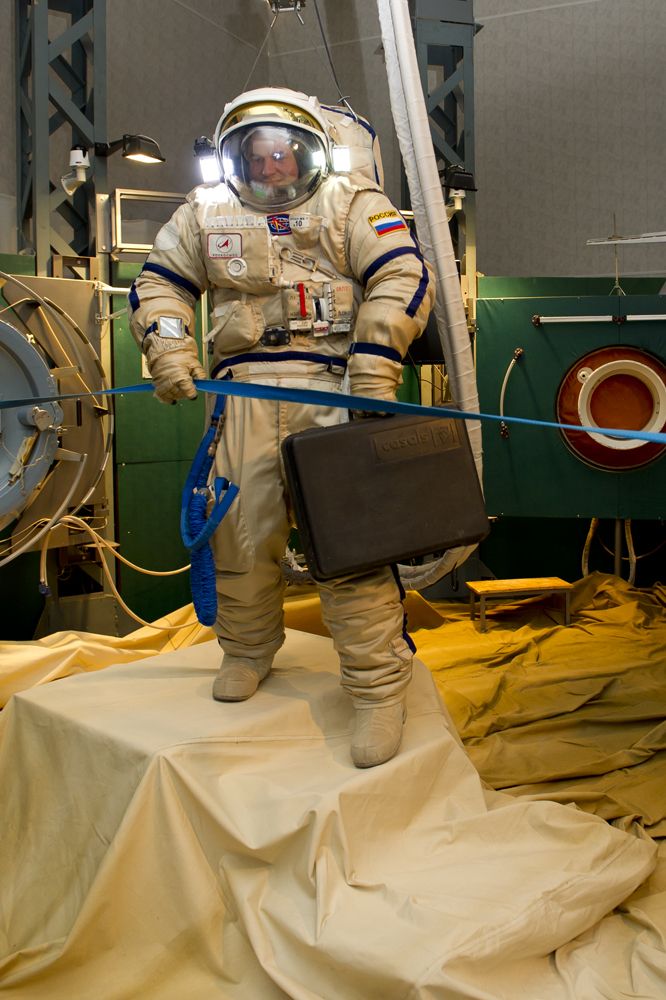 The cosmonaut moved and performed operations under the conditions of simulated hypogravitation created with the help of GCTC special Egress-2 simulator. This simulator is equipped with active weightlessness simulation system and is designed for practicing airlock operations in Orlan spacesuits. In the process of preparation the simulator was modernized for extravehicular activities under Mars gravitation that amounts to 0, 38 from Earth gravitation.
Under such conditions Roman Romanenko performed the following operations:
– Spacesuit Orlan systems and other equipment control in the process of air-locking
– Movement along the planet surface
– Ascent and descent along the stepway
– Electrical connector adapting
– Antenna installation and removing
The experiments carried out in GCTC showed that the cosmonauts are able to perform operator’s activities on the surface of the planet even after half a year flight under weightlessness condition, – GCTC press-service reported.
Image credit – Gagarin Cosmonaut Training Center