March 10, 2015
Categories: GCTC, ISS, Space, Star city

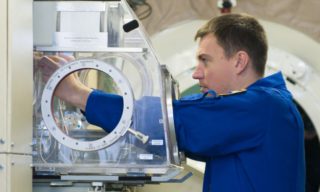
Russian cosmonaut Gennady Padalka expects to set up a new record spending 1000 days on the orbit,  as he told the journalists at press-conference taking place in Star City on Friday.

Being a member of the international crew Padalka will go to the ISS in March 2015. Thus he will beat the record of the other Russian cosmonaut Sergey Krikalyov who spent 803 days on the orbit performing 6 spaceflights.

“Currently total duration of my work in space amounts to 710 days. After this flight I hope it will be 878 days. But I am not going to stop at that, and during the next flight I hope to achieve 1000 days of orbit work. Or may anyone else do that, – the cosmonaut stated.

At the same time Gennady Padalka noted that he is not going to take part on Moon or Mars exploration programs.

“I suppose me age at that time will not be appropriate for such program. This is the task for the next generation.  There are a lot of young cosmonauts in the corps, who, I believe will fly to the Moon and Mars”, – the cosmonaut concluded.

Photo credit: GCTC

More from this category:
May 8, 2015

Russian cargo vehicle Progress M-27M re-enterned the atmosphere and burned  in the region above the Pacific Ocean on Friday, May 8, at 05.04, Moscow time….

full story
July 21, 2014

Russian biosatellite Foton-M with 5 geckoes, fruit flies, higher plants’ seeds and other biological materials onboard was launched with the help of Soyuz-2.1a booster from…

full story
December 25, 2013

Three military space devices launched by Rokot booster and Briz-KM from Plesetsk spaceport on Wednesday were successfully orbited, – Russian Defense Ministry Aerospace Defense troops…

full story
June 29, 2015

On June 28, 22.42 UTC (June 29, 01.42, Moscow time) Russian Cosmonaut Gennady Padalka set a new world record in overall space flight time breaking…

full story
July 19, 2021

The chair to be installed inside the future Russian space vehicle Oryol (rus. Eagle) designed for moon mission proved to be reliable in the course…

full story
July 1, 2013

Proton-M booster with 3 GLONASS-M satellites planned to be launched on July 2, 2013 was rolled out to the launching complex of Baikonur spaceport, Khrunichev…

full story
September 4, 2013

Joint operations on assembling of Proton-M booster nose cone for Astra-2E telecommunication satellite launch started in 92-A50 integration building of Baikonur spaceport, – Khrunichev Centre…

full story
February 5, 2014

Russian 2014 space program implementation starts on February 5, 20014 with Progress M-22M cargo vehicle launch. The vehicle will deliver more than 2,5 tons of…

full story