March 29, 2016

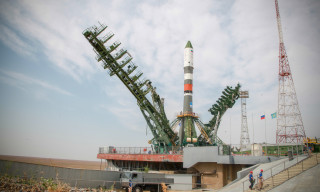
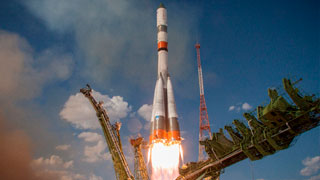
Aerospace indstry specialists completed general assembling of Soyuz-2.1a booster that is to launch new Russian cargo vehicle Progress MS-02 on March 31, – Roscosmos spokesman reported.

“On March 28 Soyuz-2.1a general assembling with nose fairing containing Progress MS-02 cargo vehicle was successfully completed at Baikonur spaceport”, – was  stated in official report by Roscosmos.

“Cargo vehicle will deliver to the station propellant components, oxygen, equipment for scientific experiments, parcels for crew members, containers with foodstuff and water. Progress docking with the ISS is scheduled for April 2”.

More from this category:
July 16, 2015

On June 15, 2015, Baikonur saw “Mass Media day” taking place in GCTC test and training center of #17 launchpad. Soyuz TMA-17M spacecraft main (Oleg…

full story
November 2, 2020

Twenty years ago on November 2 the first  long-duration space mission crew arrived aboard the ISS. Russian cosmonauts Yuri Gidzenko and Sergey Krikalyov and American…

full story
April 4, 2014

Russian Soyuz-ST booster with European scientific Earth remote sensing satellite was successfully launched from Kourou spaceport in French Guiana, – the Head of European space…

full story
May 22, 2015

Asteroid danger is one of the main threats to the mankind, – stated cosmonaut Alexei Leonov twice Hero of the Soviet Union speaking on Tuesday…

full story
September 20, 2019

From the territory of the Lavochkin NPO (part of Roscosmos State Corporation) 3 containers were dispatched with “Fregat-M” upper stages. On September 19, 2019, products…

full story
August 22, 2019

On August 22, 2019 at 06:38:32 (Moscow time) the “Soyuz-2.1a” launch vehicle with the “Soyuz MS-14” spacecraft was successfully launched from the launch pad of…

full story
May 20, 2015

It is too early to replace proton with Angara since this is a new rocket and it didn’t have enough time to accumulate positive flight…

full story
December 10, 2021

The Soyuz MS-20 crewmembers opened the transfer hatches between the ship and the Poisk module of the International Space Station Russian segment. Roscosmos cosmonaut Alexander…

full story