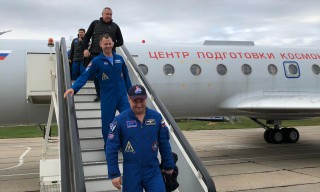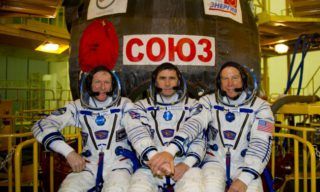


Soyuz TMA-19M descent capsule with Roscosmos cosmonaut Yuri Malenchenko, NASA astronaut Timothy Kopra and ESA astronaut Timothy Peake successfully landed in the steppe of Kazakhstan to 147 km of Jezkazgan town on June 18, 2016, 12.15, Moscow time, – MCC spokesman reported.
During the descent the crew experienced g-loads up to 4g.
Short after the landing medical specialists examined the cosmonauts. Then the cosmonauts were brought to their space centers for rehabilitation by special charters. Yuri Malenchenko – to Star City, the astronauts – to USA and Europe respectively.
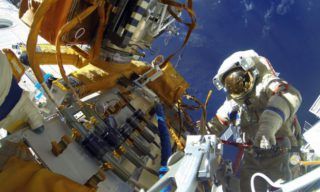
For the period of their work onboard the station ISS-46/47 crew has conducted a series of various scientific experiments (in the field of medicine, space biology, biotechnology, physicochemistry, etc.). About 50 of them were conducted by Yuri Malenchenko. Besides Russian cosmonaut performed a spacewalk, coping with all the tasks set in 4 hours 43 minutes.
The crew worked with Russian (Progress) and foreign (Cygnus, Dragon) cargo vehicles, accomplished works on station maintenance, made onboard photo and video shooting and prepared their spacecraft for deorbiting. The period of crew’s stay onboard amounts to 186 days.
At the present time Russian cosmonauts Alexei Ovchinin and Oleg Skripochka and NASA astronaut Jeffrey Williams go on working onboard the ISS waiting for the new crew members.
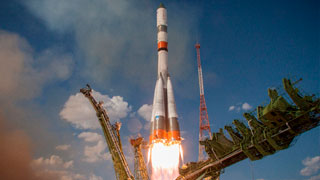
Soyuz-MS will be launched on July 7, 2016 (instead of June 24). The crew comprises Roscosmos cosmonaut Anatoly Ivanishin, JAXA astronaut Takuya Onishi and NASA woman-astronaut Kathleen Rubins.