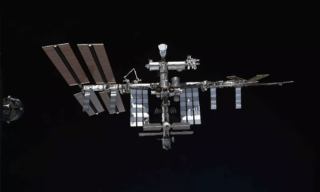


Yesterday, on February 03, 2016, Russian cosmonauts Yuri Malenchenko and Sergey Volkov sucessfully completed the first spacewalk in accordance with Russian ISS flight program for 2016.
The cosmonauts removed monoblock exposing organic and biologic specimen to the conditions of open space in the framework of Expose-R experiment and installed another block with #2 specimens on Poisk miniature research module for “Endurance” experiment aimed at studying space impact on mechanical properties of matter. On Poisk module they also replaced container with ISS outer covering samples being exposed to space factors for a long period of time and changed pressure and suppression control unit attitude on Miniature Research Module-2.
During EVA Malenchenko and Volkov also conducted “Restoration” experiment. One of its tasks was to practice techniques of multilayer isolation fastening on ISS surfaces being restored.
On the whole the aim of “Restoration” experiment is to practice techniques of film thermal protection coating pasting and multilayer isolation fastening on surfaces being repaired and conducting operations requiring film matter pasting under conditions of space flight.
Besides Malenchenko and Volkov also practiced new methods of leak detection and ISS outer surface monitoring and took samples from Pirs module exit hatch and Zvezda service module window.
To make movements along ISS surface more convenient the cosmonauts installed soft handrails on the flare section of Zarya functional cargo block pressurized propulsion module and upon completion of all these operations made pictures of ISS Russian segment surface.
For Yuri Malenchenko this spacewalk was the sixth one in his space career. Sergey Volkov went to the open space for fourth time.
Currently ISS crew also comprises Russian cosmonaut Mikhail Korniyenko, NASA astronauts Scott Kelly and Tim Kopra and ESA astronaut Tim Peake.
Earlier it was reported that the cosmonauts could have been working in space in new modernized Orlan-MKS spacesuits equipped with automated thermal control system so that they wouldn’t spend time to turn thermal system on and off. But new spacesuits haven’t been delivered to the station yet that’s why Malenchenko and Volkov performed the spacewalk in Orlan-MK.
European Space Agency thanked Russian cosmonauts for their work in the open space.
In the framework of experiment ESA sent to the ISS 46 species of microorganisms and more than 150 specimens of organic compounds that were installed on the outer surface of Russian Zvezda module and stayed there for 18 months.
The specimens will be sent back to the Earth for further studies. It is expected that the experiment will help scientists in the search of extraterrestrial life forms since chemical analysis of the specimen will enable them to learn how molecules respond to the factors of space flight.