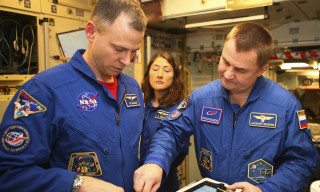


The start of a new expedition to the ISS is steadily approaching: at the Yuri Gagarin Cosmonaut Training Center, its future participants – Alexey Ovchinin, Ivan Wagner, and Donald Pettit – spent eight hours on a special simulator simulating the Russian segment of the station. By doing so, they got an idea of what a working day in space looks like and practiced parrying emergencies.
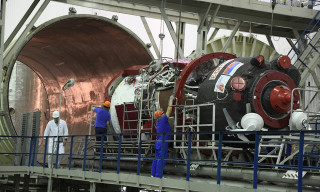
Usually, before sending people on a long mission to the International Space Station, ground services repeatedly make sure that the cosmonauts are capable of solving any problem they encounter. Ovchinin, Vagner, and Pettit underwent one such test on Monday. Locked in a compartment that perfectly replicated the station’s interior (except for the lack of weightlessness), the cosmonauts fully experienced what a typical flight day is like.
The main kind of activity in orbit is conducting scientific experiments. First of all, engaged with the future guests of the ISS: in a special box, they set up a biological experiment called “Aseptic”, collected samples of nutrient medium, and carefully packed them in special capsules “Air” and “Surface”, designed to return to Earth. In addition, the test subjects conducted conditional remote sensing of the Earth, passing the resulting images and videos to specialists.
At the same time, the GCTC staff constantly created abnormal situations for the cosmonauts, the consequences of which had to be dealt with, abandoning scientific activities in the middle. Problems with radio communication, malfunction of the oxygen supply system, failure of the onboard computer network, or a banal breakdown of the galley – an incomplete list of what “happened” on the conventional station.
Shortly before the end of the work day future crew even had to put out the fire, which is one of the most dangerous threats to the inhabitants of the ISS. However, none of the test subjects were confused: all accidents were overcome quickly, clearly, and by established methods. Probably, the fact that all cosmonauts already have experience in space flights played its role.
As a result, the staff of the Training Center gave all three an “excellent” grade, thus signaling that the crew was ready to go into orbit. However, the final exam is still ahead: it will be held a week later, on August 20. And on the 21st, the same exams are scheduled for the backup crew. So far, everything points to the fact that the launch of the ISS-72 expedition in September 2024 will take place exactly on schedule.