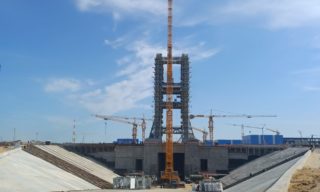




Kazakhstan hopes to start operating “Zenit” rocket and space complex facilities of Baikonur spaceport by the end of 2014, – “Kazcosmos” national company Deputy President Meirber Moldabekov reported on Tuesday.
“We plan to stop renting out “Zenit” rocket and space complex facilities by the end of 2014 and to start operating it ourselves. Later when we learn from our Russian colleagues how to operate this complex we’ll be able to modernize it, say in 2018, to increase Zenit booster payload capacity and replace Proton booster with this new Zenit one, – Moldabekov stated at the briefing in Astana.
According to him it will be possible to replace Proton boosters with Zenit totally by 2025.
“Thus we can solve 2 problems. The first issue concerns Kazakhstan’s participation in technological launch operations taking place at Baikonur spaceport and due to “Zenit” rocket and space complex modernization we’ll be able to shut Proton program down and eliminate our ecology problems’, – he added.
Moldabekov reminded that “Baiterek” project works were suspended since the Russian party was unable to finish Angara booster in time. “According to plans it had to be launched in 2008 but the booster hasn’t been launched yet. At the present time the launch is scheduled for 2014”, – Moldabekov specified.
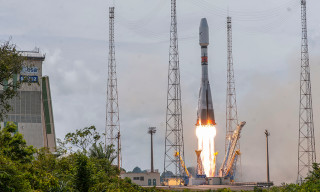
That’s why we decided to choose another way. Here at Baikonur we have another booster which is the latest USSR development. It is an environmentally friendly modern booster and it’s been launching from Baikonur spaceport since 1985. Upon Kazcosmos’ suggestion the Heads of Both states came to an agreement to use Zenit boosters instead of Angara in the framework of “Baiterek” project. It is not clear when Angara will be launched. So this option is much more profitable for us since we do not bear any costs as the complex already exists”, – he concluded.