
Roscosmos will create a new satellite constellation for Earth remote sensing “Autograph”. In the first stages, it will include 14 small Pixel-BP spacecraft. The satellites will make it possible to observe the surface of our planet, including natural hazards tracking. One of the features will be the ability to create high-quality images in low-light conditions.
The Autograph orbital system will consist of 14 Pixel-BP satellites, arranged in seven planes – two in each. This pattern will make it possible to cover up to 240 thousand square kilometres per day or one area up to twice daily. In the future, the constellation is planned to be expanded to 72 spacecraft. The Russian Space Systems holding company and the Lavochkin Research and Production Association are responsible for its creation.
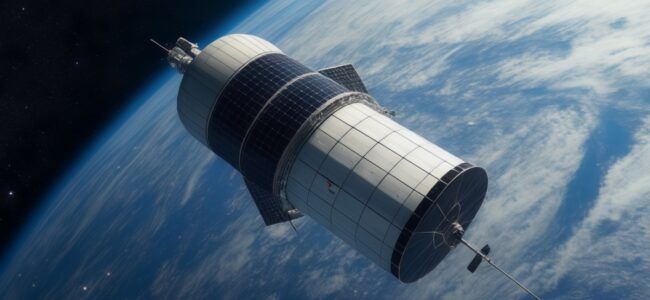
In terms of size “Pixel-BP” will be quite small – their dimensions are 1x1x1.9 metres. However, despite their compactness, the satellites will be able to fulfill a number of tasks, including observation of infrastructure objects in ultra-high spatial resolution and provision of high-quality operational remote sensing data for citizens, government, and businesses.
The satellites of the series will be placed in a sun-synchronous orbit with an altitude of 500-700 kilometres, from where they will be able to carry out detailed optical and electronic observation of the Earth in the visible and near-infrared spectrum. The first version of the spacecraft will weigh 600kg, but in the second one, when the number of satellites in the constellation grows, the spacecraft will be made twice as light – it’s mass will be reduced to 300kg.
The first two spacecrafts for the Autograph constellation will be based on the Karat-200 satellite platform developed by the Lavochkin NPO. The platform has been used to build small spacecrafts for fundamental space research, in particular Zond-PP and Vernov. This method of production will make it possible to create satellites in a short time and test the new camera, the press service of Roscosmos explains. Later, a new platform will be developed for satellites of this series, which will make it possible to establish serial production.
As noted in the press service of RSS, the satellites of the grouping “Autograph” will use a new technology that will make it possible to make high-quality images of the Earth’s surface in low light conditions. It will be possible to do this thanks to the system of photo matrix movement, which increases the time of accumulation of the required objects when creating a frame. As a result, even low-contrast objects in the photo are clear.
The service equipment will be able to automatically transmit information to ground stations. It will be received by the infrastructure of the Unified Territorially Distributed Information System of Earth Remote Sensing in the European, Siberian, Far East, and Arctic regions of Russia. Data will be processed, systematised, archived, and provided to customers by the RSS Scientific Centre for Operational Earth Monitoring in Moscow. Information support for the satellite launch into orbit will be provided by the complex measurement, data collection, and processing facilities at the Vostochny Cosmodrome created by RSS. The spacecraft will be controlled by specialists from the Mission Control Centre at the Central Research Institute of Mechanical Engineering.