December 1, 2014

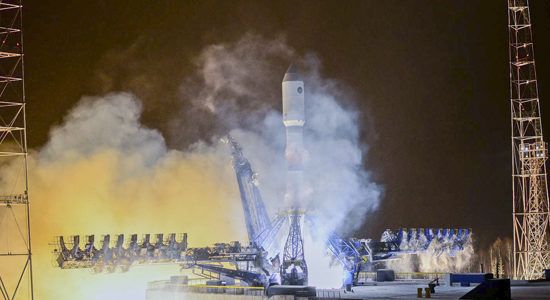
The second Russian new generation navigational satellite Glonass-K was successfully orbited, – Russian Ministry of Defence Aerospace Defence troops press-office representative colonel Alexey Zolotukhin reported.

Glonass is a Russian analogue of American GPS navigation system being at the present time nos as accurate as its American counterpart. Glonass-K is the third generation of Glonass system satellites (after Glonass and Glonass-M). First satellites of Glonass-K generation  were orbited in 2011, these satellites will be launched by 2020.

Glonass-K is to increase the accuracy of the system.

Soyuz-2.1b booster with Glonass-K satellite was successfully launched from Plesetsk spaceport situated in Arkhangels region on Monday, December 1, 2014,  00.52, Moscow time.

“Soyuz-2.1b booster with the help of Fregat upper stage successfully set Russian navigational satellite into the orbit”,- Zolotukhin stated.

Upon the separation at 04.25, Moscow time, Titov Main Test Space Centre belonging to Aerospace Defence Troops Space Command took control over the satellite.

Titov Centre situated in Krasnoznamensk (Moscow region) controls 80% of Russian orbital group satellites (except missile warning system satellites controlled by another authorities).
More from this category:
April 12, 2019

The train with the “Proton-M” launch vehicle, the “Briz-M” upper stage, the head fairing and the transition system, designed to launch the powerful geostationary satellite…

full story
January 15, 2020

The Roscosmos State Corporation considers the launch of the production of universal rocket modules of “Angara” launch vehicles at the Production Association “Polet” (a branch…

full story
November 19, 2013

Express-AM5 Russian communication satellite developed and designed by Reshetnev “Information satellite systems” Company was delivered to Baikonur spaceport from where it will be launched. “The…

full story
April 22, 2014

The launch of Russian-German SPACE observatory designed to study black holes, galactic clusters and dark matter was shifted to 2017 since German specialists fail to…

full story
August 31, 2022

This July Roscosmos State Corp and NASA signed an agreement on cross-flights, under which American astronauts will fly on Russian Soyuz spacecrafts, and Russian cosmonauts…

full story
October 20, 2014

At 04:30 on October 18 Proton-M booster Briz-M upper stage and Express-AM6 satellite was transported from fuel servicing area where Briz-M low-pressure tanks were filled…

full story
July 29, 2013

Progress M-20M cargo vehicle successfully docked to the ISS on Sunday delivered to the orbit equipment necessary to repair American EMU (Extravehicular Mobility Unit), spacesuit,…

full story
July 11, 2013

New communication satellites launch schedule for 2013 may be changed by Roscosmos due to the recent Proton-M crash, – Russian Ministry of Communications and Mass…

full story