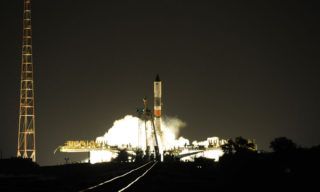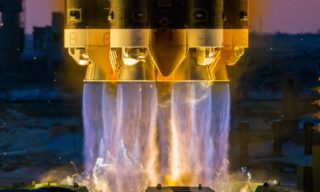
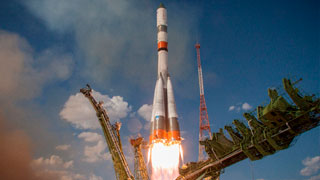

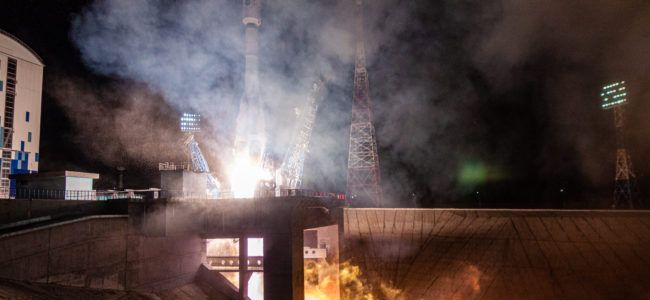
On October 14, 2021, at 09:40:10 Moscow time, the launch crews of Roscosmos subsidiaries launched a space rocket from the Vostochny Cosmodrome consisting of a Soyuz-2.1b launch vehicle, a Fregat upper stage and 36 OneWeb spacecraft under Mission 49. 562 seconds after liftoff, at 09:49:32 UTC, the upper stage separated from the rocket’s third stage in a suborbital trajectory. This was the 17th launch of Russian space rockets in 2021.
According to telemetry information from the Roscosmos Central Information Station, the launch, stages and the orbital unit separation went flawlessly. After that, the Fregat upper stage continued to inject 36 spacecraft into orbit. To reach the target circular orbit altitude of 450 kilometers, the booster produced by NPO Lavochkin (part of Roscosmos) will fire its cruise engine twice. According to the flight sequence, the separation of satellites is planned in nine stages in different points of the orbit between 10:58 UTC to 13:31 UTC on October 14, 2021. This launch will bring OneWeb’s low-orbit constellation to 358 satellites.
Today’s launch was the sixth commercial launch from the Vostochny Cosmodrome under contracts between Glavkosmos (part of Roscosmos), Arianespace, a European launch services provider, operator of OneWeb launches using Soyuz-2 launch vehicles and Starsem for OneWeb satellite constellation operator from the Russian launch site.
The Soyuz-2 launch vehicle is based on the Soyuz-U mass-produced rocket. The Progress Rocket and Space Center (Samara, part of Roscosmos) acts as its head developer. The Soyuz-2 family rockets use advanced propulsion systems and modern control and measurement systems, which improve technical and operational performance. Structurally, as all the Soyuz family rockets are based on the consecutive separation of rocket stages. In combination with the Fregat upper stage it is intended for launching spacecraft into near-Earth orbits at various altitudes and inclinations, including geostationary and geostationary transfer orbit, as well as outgoing trajectories.
The first and second stages employ the RD-107A and RD-108A liquid-propellant rocket engines, with the four-chamber RD-0124 engine in the third stage. The RD-107 and RD-108 engines developed by Russia’s NPO Energomash (Khimki, part of Roscosmos) are reliably used to perform Russia’s programs of crewed and uncrewed flights. To date, the basic RD-107 engines for the first stage and RD-108 engines for the second stage have seen 18 modifications for various programs.