
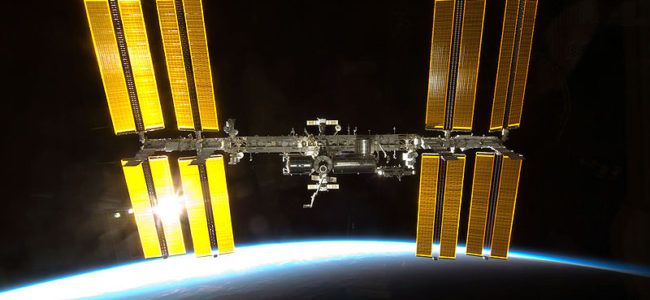
The International Space Station is a stronghold of the mankind on the orbit. It goes round the Earth 16 times a day at the height of about 400 km. The ISS is the largest flying object, designed by leading space countries. “Man-made star” weighting more than 400 tons is a complex scientific and technical object and the largest orbital station throughout the history of mankind.
The ISS owes its creation to several historical space objects: first orbital stations being a scientific breakthrough each. “Salut” space laboratory-stations were the first to gain constant orbital velocity of 28000 km per hour. Soyuz-Apollo program in its turn laid the basis for future international cooperation, while Mir space station facilitated exploration of the work in the open space.
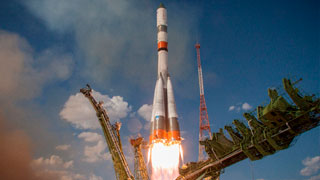
In March 1993 Russian Space Agency Director General Yuri Koptev and Energia Scientific Development and Production Center General Designer Yuri Semenov suggested NASA Head Daniel Goldin a project on International Space Station creation. After the project was approved in 1994 the first modules designing began. “The birthday” of the ISS is considered to be on November 20, 1998 when “Proton” booster with “Zarya” functional cargo block that has become the first element of new station was launched from Baikonur spaceport. On December 7, 1998 “Endeavor” shuttle docked American “Unity” segment to “Zarya” module, on July 26, 2000 “Zvezda” service module was docked to “Zarya” and became the centre of Russian segment. In November 2000 Soyuz TM-31 brought the first mission crew to the ISS.
The crew consisted of William McMichael Shepherd (ISS commander, Soyuz TM-31 flight engineer), Yuri Pavlovich Gidzenko (ISS flight engineer, Soyuz TM-31commander) and Sergey Konstantinovich Krikalev (ISS flight engineer, Soyuz TM-31 flight engineer). Within 15 years 11 more modules were sent to the ISS : American “Destiny”scientific module, European “Calambus” scientific module, Japanese “Kibo” module and others.
The ISS works using solar arrays energy. When it flies across the solar part of the orbit wide arrays accumulate solar energy which is used when the station flies in the shadow. Due to the satellites and other modern means of communication ISS stays in constant contact with the Earth. The main Mission Control Centers are situated in Huston (USA) and Korolev (Moscow region, Russia).
The ISS is also a laboratory testing new technologies. A great deal of experiments requiring unique conditions of space flight such as Zero-G, vacuum, space radiation are conducted onboard the ISS. Most part of materials and devices we are using now were first tested onboard the ISS: teflon, microwave ovens, metal allegations, water regeneration systems, medicines and vaccines.
Photos made from space help farming and combating natural disasters. ISS proves that people can stay in space for quite a long period of time. Due to ISS existence we may study the working abilities and endurance of human organism. Day after day ISS gives us new knowledge and discoveries.
All great journeys started with a small step and the ISS may become an outpost for Moon, Mars and other distant corners of the Universe exploration.