February 11, 2019
Categories: GCTC, Roscosmos, Star city

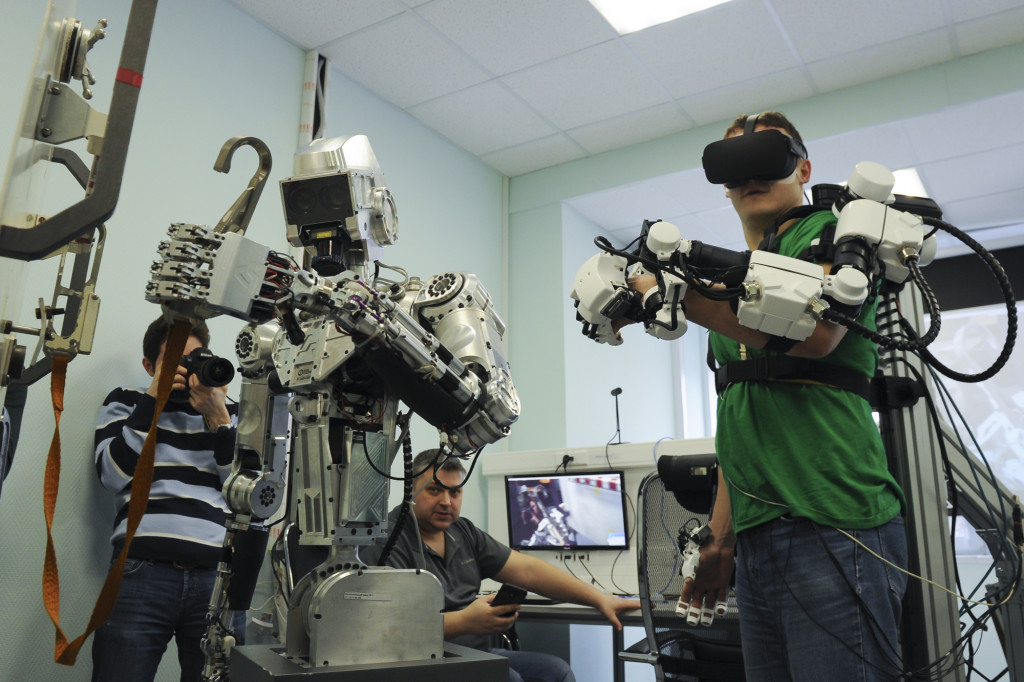
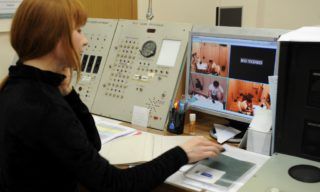
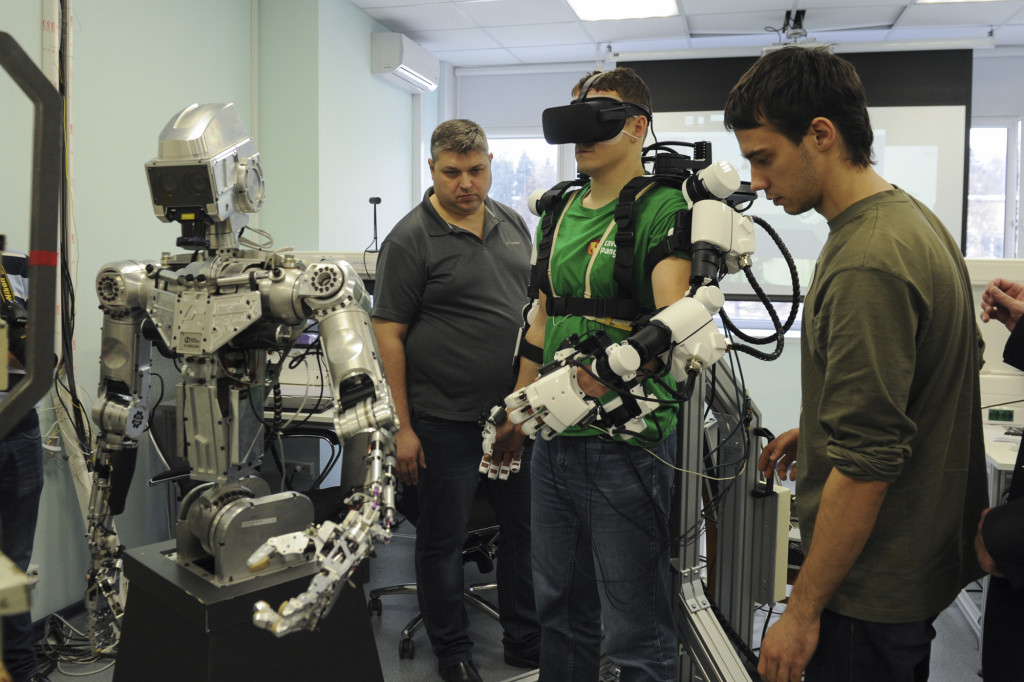
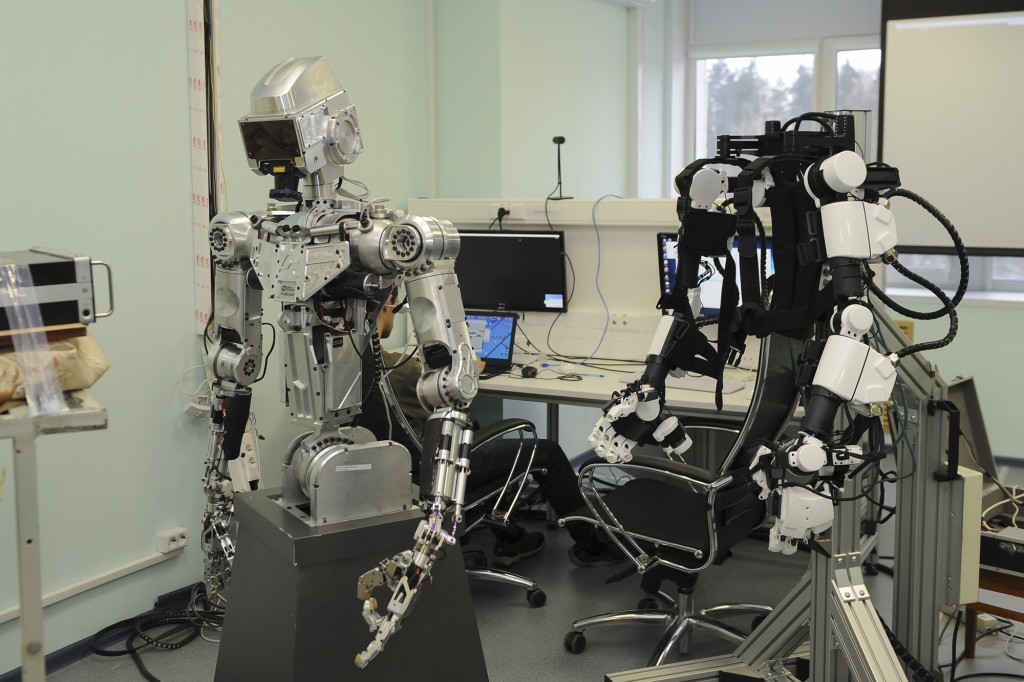
Today, at the GCTC has completed experimental studies on the development of interactions between the cosmonaut and the anthropomorphic robot, which is controlled in a teleoperator mode.

The goal was to develop a standard technique, that could be further replicated for various studies.

As test operators, six test cosmonauts led by Oleg Novitsky, acting cosmonauts team commander, as well employees of the GCTC took part in the experiment.

Since at the beginning there was no understanding of how quickly an cosmonaut could train for robot telecontrol, for each operator, the experiment staff did two two-hour sessions.

The first is a training one, where the cosmonaut initially works without virtual reality glasses, adapts to the exoskeleton (master), performs operations, observing with his own eyes what he does.

And then performs experimental actions already in glasses of virtual reality, looking at things through the eyes of a robot.

As a result – two hours is more than enough for our cosmonauts.

Everyone quickly learned to control an anthropomorphic robot.

The second lesson is a checking test, where time and quality of operations were recorded.

As a result, the staff of the experiment concluded, that a person very quickly adapts to simple operations.

The experiment equipment includes a screen, a projector, automated workplaces of the experiment support team.

Now it is exploring an anthropomorphic robot, created by the NPO “Android Technics”, with which the GCTC has been cooperating for a long time.

But in the future, the interaction of cosmonauts with any other space robots will be tested here.
2430064655

5166842078

6105874042

More from this category:
January 31, 2019

The Institute for Biomedical Problems of the Russian Academy of Sciences continues preparations for the SIRIUS-19 international isolation experiment. Start of the experiment is scheduled…

full story
March 14, 2016

Proton-M booster with ExoMars-2016 station designated to search for life forms on Mars was launched from Baikonur spaceport today on March 14, 2016. The main task…

full story
July 7, 2020

The first launch in six years of the new-generation navigation satellite Glonass-K from the Plesetsk cosmodrome is scheduled for August. “The satellite’s delivery to the…

full story
October 21, 2014

ISS-41/42 mission commander Maksim Surayev and flight engineer Alexander Samokutyayev will perform the spacewalk on October 22, 2014 in accordance with the ISS flight schedule….

full story
January 27, 2015

Preparation works for Proton-M with Inmarsat-5F2 satellite launch are under way at Baikonur. Yesterday, January 26, 2015,  in 92A-50 integration building of Baikonur spaceport rocket…

full story
March 13, 2014

ISS orbit was increased by 2 kilometers with the help of Progress M-21M cargo vehicle thrusters, – Mission Control Centre representatives reported. The thrusters were…

full story
December 10, 2014

Last weekend specialists started general assembling of Proton-M booster in 92-A50 integration building. The booster  will launch Russian Yamal-401 telecommunication satellite in mid-December, – Khrunichev…

full story
November 25, 2015

New ISS mission back-up crew commander Russian cosmonaut Anatoly Ivanishin says he feels very responsible since his crew will be the first one to go…

full story