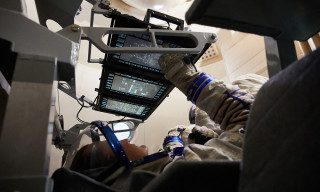

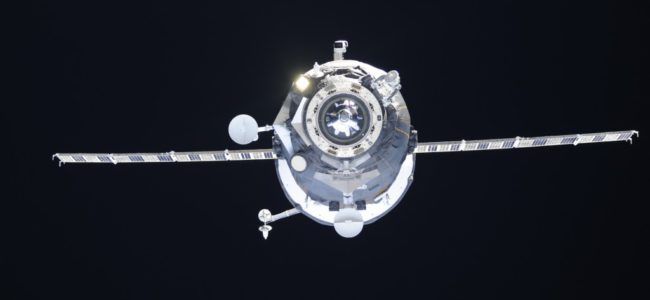
On Saturday Russian cargo vehicle Progress M-21M nominally docked with the ISS. However at the final stage of the docking the specialists made a decision to use manual docking successfully performed by ISS cosmonaut Oleg Kotov.
Apart from Kotov Roscosmos cosmonauts Sergey Ryazansky and Mikhail Tyurin, NASA astronauts Michael Hopkins and Richard Mastracchio and JAXA astronaut Koichi Wakata are keeping their watch onboard the ISS.
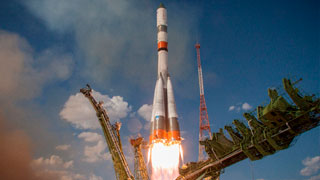
Progress M-21M was launched with the help of Soyuz-U booster from Baikonur spaceport on November 26, 2013. The spacecraft flew to the ISS not in accordance with the short rendezvous scheme since new “Kurs-NA” docking system had to be tested. Before Progress-M-16M spacecraft that was the 1st to fly to the ISS in accordance with the short scheme on August 2012 all cargo vehicles flew to the ISS in accordance with 2-days rendezvous scheme. “Short” scheme was tested on cargo vehicles to use it later for Soyuz manned spacecrafts. Now several Soyuz spacecraft have already flown to the ISS successfully in accordance with the short scheme.
This “Progress” delivered to the ISS foodstuffs and water for the crew. Besides cargo vehicle also brought to the station books, presents, propellant in refueling complex tanks, medical equipment, clothes, personal hygiene means and scientific equipment for experiments conducted onboard the ISS. “Progress” also delivered equipment for American ISS segment, foodstuffs and health aids. The total weight of all cargos amounts to about 2,4 tons.
Final Frontier
Progress had to be the 1st cargo vehicle docked with the ISS with the help of modernized “Kurs-NA” rendezvous system and almost the whole maneuver was successfully carried out in accordance with it. However at the final stage when the spacecraft was just several dozen meters from the station the maneuver was carried out manually by Russian cosmonaut Oleg Kotov.
Mission Control Centre representative reported that “Kurs-NA” system wasn’t used any more after shifting to manual mode.
Up to the present time Progress cargo vehicles used “Kurs” system. New “Kurs-NA” modernized system has new hardware components, and new digital software that enables to dock progress cargo vehicles with the ISS from longer distances and with higher accuracy, – RSC Energia representative reported earlier.
On November 28 Progress M-21M successfully approached the ISS to test new “Kurs-NA” system. After that the spacecraft retreated to a safe distance (about 100 km) from the station using its thrusters to dock with the ISS on Saturday. That time both systems the one installed on Progress spacecraft (active) and that installed on Zvezda service module (passive) operated nominally.
The reason to be found out by Tuesday
The reason of shifting to manual mode is not clear yet. The commission working on this issue will find it out by Tuesday, – Russian ISS segment flight director Vladimir Solovyov reported.
Mass media reported earlier that manual mode was used because of new rendezvous system failure at the distance of 60 meters from the ISS.
“Manual docking for us is a nominal mode. Progress docked with the ISS as was planned. The reason is not clear yet. We’ll find out what’s happened by Tuesday, – Solovyov stated. – We cannot speak that manual mode was used because of “Kurs-NA” system failure, special commission works on this matter to find out the reasons why manual mode was used.
Image credit – Roscosmos