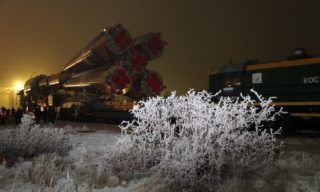
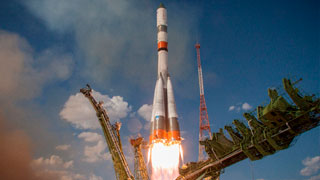


On Wednesday, September 21, 2022, at 16:54:49.531 Moscow time, the Soyuz-2.1a launch vehicle with the Soyuz MS-22 manned spacecraft (K.E. Tsiolkovsky”) and the crew of the 68th long-term expedition launched to the International Space Station.
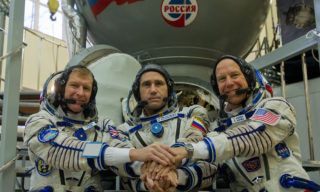
The crew includes Roscosmos cosmonauts Sergei Prokopyev and Dmitry Petelin and NASA astronaut Francisco Rubio.
The launch of the Soyuz MS-22, its separation from the third stage of the rocket, the opening of the antennas and solar panels of the ship were carried out nominally.
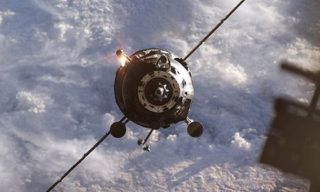
On Wednesday, September 21, 2022, at 20:06:33 Moscow time, the manned spacecraft Soyuz MS-22 (K.E. Tsiolkovsky) after two-orbit rendezvous scheme docked to the Rassvet research module of the Russian segment of the International Space Station. After opening the transfer hatches between the Soyuz MS-22 spacecraft and the Rassvet module, they joined Roscosmos cosmonauts Oleg Artemyev, Denis Matveev and Sergey Korsakov, NASA astronauts Chell Lindgren, Robert Hines and Jessica Watkins, and European Space Agency astronaut Samantha Cristoforetti.
The ship is named K.E. Tsiolkovsky” in honor of the 165th anniversary of the birth of the founder of theoretical cosmonautics Konstantin Tsiolkovsky. On board, in addition to the crew, there are about 120 kg of payloads, including sanitary and hygienic supplies and medical control, on-board documentation and consumable items of service equipment, clothes and personal belongings of astronauts, food rations and fresh food, as well as packing for carrying out scientific experiments.
During the 68th long-term expedition to the ISS with a planned duration of 188 days, five spacewalks are planned according to the Russian program, as well as the arrival of the Russian Progress MS-21 and Progress MS-22 cargo ships.
In July 2022, within the framework of the ISS program, Roscosmos and NASA signed an agreement on cross-flights of Russian cosmonauts on American manned spacecraft and American astronauts on Russian manned spacecraft. The flight of NASA astronaut Francisco Rubio on the Soyuz MS-22 was the first of them, and on October 3, 2022, Roscosmos cosmonaut Anna Kikina, as part of the Crew-5 crew, will go to the station on the Crew Dragon spacecraft. The implementation of the agreement will make it possible, in case of cancellation or a significant delay in the launch of a Russian or American spacecraft, to ensure the presence on board the ISS of at least one Roscosmos cosmonaut and one NASA astronaut to serve the Russian and American segments of the station, respectively.