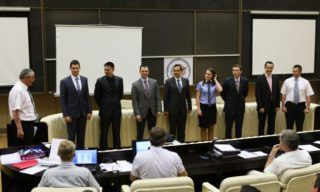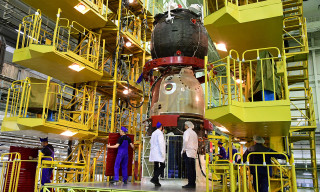


Alexey Ovchinin and Ivan Vagner, as well as their understudies Sergei Ryzhikov and Alexey Zubritsky, practised the operations they will perform during the spacewalk.
The training of the main crew was devoted to consolidating the skills of performing forward and reverse airlocking, using the main and reserve airlock compartments of the ISS RS on the Egress-2 simulator. During this process, the cosmonauts performed several operations to ensure safe operation outside the station. These included checking the tightness of spacesuits and the hatch separating the ISS compartments from the MRM 2 airlock. The same actions were taken during the reverse airlocking of the hatch through which the crew left the station and returned to the ISS.
During the work of Alexey Ovchinin and Ivan Vagner, the simulator specialists introduced for them various emergencies related to failures of the airlock equipment. The cosmonauts, guided by the onboard instructions, identified and eliminated the problems.
The backup crew consisting of Sergey Ryzhikov and Alexey Zubritsky had a comprehensive practical training session, during which they honed their skills in preparing the Orlan spacesuit for a spacewalk and maintenance after the completion of extravehicular activity, as well as in dealing with additional repair and maintenance work.
– When preparing for a spacewalk, it is necessary to carefully check the spacesuit thermal regulation system and its tightness, and whether replaceable elements are installed in it. It is important for a cosmonaut to adjust the universal spacesuit to his height using special systems, as it is designed for the range from 165 to 180 cm, so that he could work in it as comfortably as possible, – Dmitry Zubov, Head of Laboratory 3 of the Cosmonaut Training Centre, told about the stage of preparatory work.
After completion of a spacewalk, cosmonauts always perform maintenance of the spacesuit: its drying, conservation, and transfer to storage mode.
During the training both crews, the main and backup crews, successfully performed all the planned operations and coped with the given abnormal situations.
Each training session differs by a different range of tasks, which are introduced by the GCTC specialists and allow to train using the “Egress-2” simulator. It is equipped with operator workstations, modules of the main, and a reserve airlock compartment with mock-up equipment. The cosmonauts are provided with ropes and a system of spacesuit “de-weighting” to realise the weightlessness mode.