July 3, 2013
Categories: Proton, Russia, Satellites

MOSCOW, July 2 – RIA-NOVOSTI. Proton-M with GLONASS satellites launch failure most likely won’t affect Russia’s position on the world space launches market , – space industry expert, corresponding member of Russian Academy of Sciences named after Tsiolkovsky Andrei Ionin believes.

“I believe the launch schedule won’t be affected and we won’t lose contracts. The matter is that there is no alternative, there is no substitution for Proton on the market. French Ariane rocket is 5 times more expensive, the Americans left the market as their rockets are too expensive and the Chinese are not presented on the market at all, ” – he told RIA.

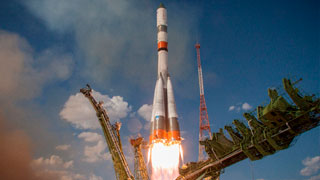
The booster with 3 GLONASS-M navigation satellites crushed at Baikonur spaceport about one minute after takeoff. As the source within space industry earlier reported the most likely causes of crash were control system and its executive units (control power units in particular) problems. In his turn Academician Pilyugin Centre (Proton-M control system developer) representative told RIA that conclusions on the crash cause could be made only when telemetry data is received.

On August 7, 2013 the launch of Proton-M booster setting Express-MD2 communication satellite and Indonesian Telcom-3 telecommunication space device into the orbit ended up off-nomilally because of Briz-M failure. Off-nominal Proton-M launch was caused by Briz-M off-nominal operation caused  in its turn by additional fuel tanks pressurization line plugging-up.
More from this category:
June 25, 2019

The crew of the “Soyuz MS-11” spacecraft, undocked today from the International Space Station (ISS), safely returned to Earth. The landing capsule with cosmonaut Oleg…

full story
April 30, 2021

On April 29, 2021, Roscosmos Director General Dmitry Rogozin, took part in a regular meeting of the Eurasian Intergovernmental Council in Kazan. During the meeting,…

full story
August 31, 2022

This July Roscosmos State Corp and NASA signed an agreement on cross-flights, under which American astronauts will fly on Russian Soyuz spacecrafts, and Russian cosmonauts…

full story
May 14, 2014

On May 14, at 05.57, Moscow time Soyuz TMA-11M spacecraft descent module successfully landed in Kazakhstan, Zhekazgan region . The landing took place in accordance with the…

full story
May 7, 2013

According to RIA-Novosti, light class booster “Angara” launch is planned for mid-2014, and by the end of the next year – the launch of its…

full story
June 17, 2021

On June 16th, 2021 in St. Petersburg, The Roscosmos State Space Corporation and China National Space Administration (CNSA) held a joint session on the auspices…

full story
April 15, 2015

Space industry specialists go on working in accordance with the ISS flight schedule. On April 14, 2015 in the integration building of #254 launchpad RSC…

full story
September 26, 2019

The spacecraft “Soyuz MS-15” at 22:42 (Moscow time) on September 25, 2019, in normal mode docked to the “Zvezda” service module of the Russian segment…

full story