August 22, 2014

Soyuz TMA-14M manned spacecraft is being prepared for the leak tests at Baikonur spaceport.

According to Roscosmos press office joint operational crews of Baikonur spaceport, RSC Energia and Yuzhny Space Centre specialists unloaded the spacecraft from special facility and transported it to the incoming inspection hall for further loading onboard the train.

Friday morning Soyuz TMA-14M spacecraft was transported to the vacuum chamber where it will be passing leak tests for several days.

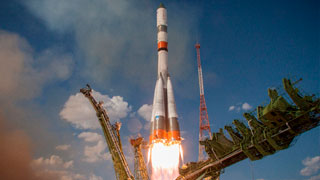
The launch of Soyuz-FG booster with Soyuz TMA-14M manned spacecraft is planned for September 26, 2014.
More from this category:
February 19, 2014

RIA Novosti – A full-scale mock-up of Russia’s first large post-Soviet rocket has been rolled out to a launch pad at the Plesetsk space center….

full story
September 11, 2013

The first after July crash Proton booster launch is planned for the second half of September, but the date is still not set, – Roscosmos…

full story
November 20, 2013

The International Space Station is a stronghold of the mankind on the orbit. It goes round the Earth 16 times a day at the height…

full story
January 30, 2019

On January 28, the RD-180 rocket engine was successfully tested in the Scientific Testing Complex of NPO “Energomash” JSC. According to Andrei Ushkov, the chief…

full story
March 12, 2014

The full name of the experiment is as follows “Determination of functional capabilities, physical working capacity level and state of main physiological systems of cosmonaut’s…

full story
November 29, 2013

Russia has no space launches planned for January 2014, but three planned for February. All these launches will take place from Baikonur spaceport, – the…

full story
June 14, 2019

Today, on June 14, 2019, in accordance with the decision of the State Commission, the “Proton-M” launch vehicle with the upper stage “DM-03” and the…

full story
December 21, 2019

Preparations are in process at the Baikonur Cosmodrome for launching the “Proton-M” launch vehicle with the DM-03 upper stage and “Electro-L” №3 Russian meteorological satellite….

full story